


























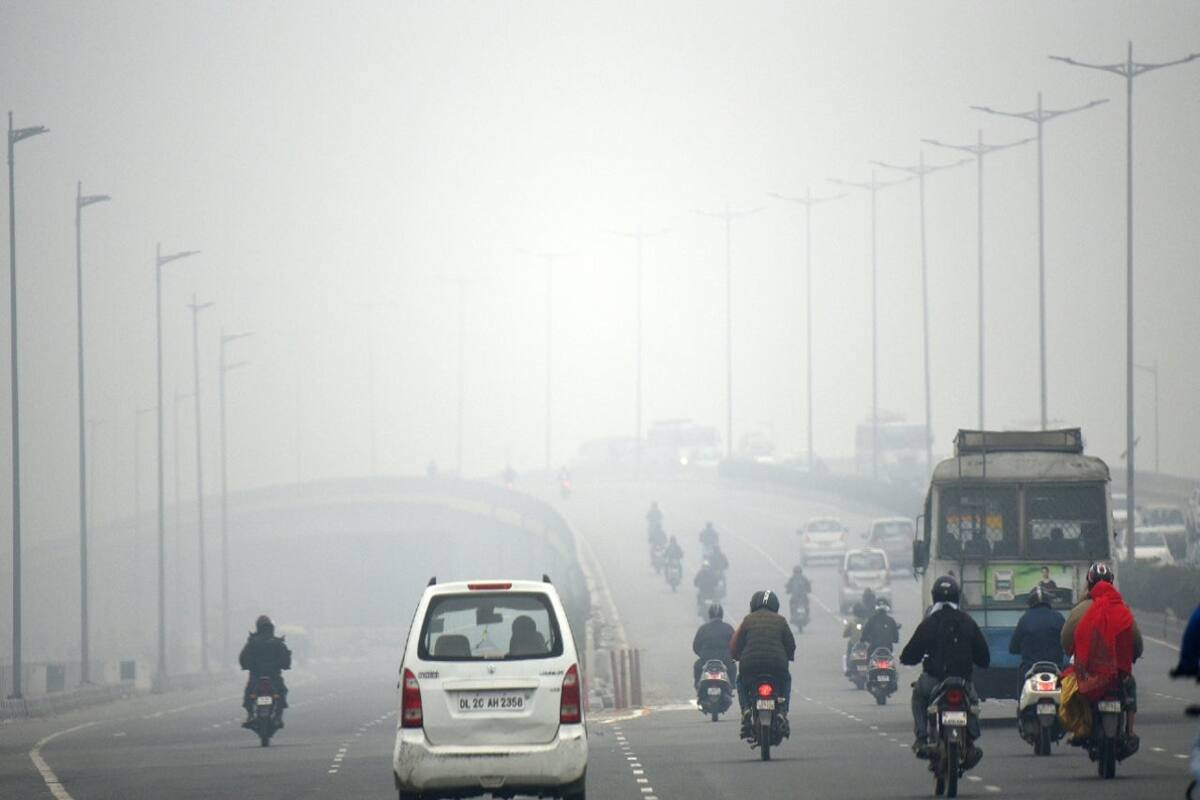
With the highest temperature in Delhi dropping five degrees to 28.3 degrees Celsius on Sunday due to rain and mild breezes, the national capital saw its greatest air quality of the year.
The Commission For Air Quality Management (CAQM) reports that on Sunday, Delhi’s air quality reached its highest point of the year.
On Sunday, Delhi’s 24-hour Air Quality Index registered a value of 45, placing it in the “good” category.
An AQI of 0 to 50 is regarded as “good,” 51 to 100 as “satisfactory,” 101 to 200 as “moderate,” 201 to 300 as “poor,” 301 to 400 as “very poor,” and 401 to 500 as “severe.”
With an average AQI of 45 (in the “Good” AQI category), Delhi saw its best air quality of the current year today. In the last two months of this year, on the 9th of September and the 29th of July, respectively, Delhi obtained Air Quality Index readings of 54 and 59 (‘Satisfactory’), according to CAQM’s post on X.
23.5 degrees Celsius, two notches below the season’s average, was the lowest temperature.
Between 8.30 am and 5.30 pm, the Safdarajung Observatory, the designated location for the national capital, reported 1.3 mm of rain. During that time, rainfall was measured at the observatories in Palam, Lodhi Road, Ayanagar, Narela, and Gurgaon at 0.2 mm, 0.8 mm, 3 mm, 1.5 mm, and 7.5 mm, respectively.
There was a wide range in humidity, between 86% and 100%.
The Municipal Corporation of Delhi received reports of 16 tree uprooting incidents and five waterlogging incidents. Calls about waterlogging were made to the public works department by people in Mundka and Narela, among others.
During the last two days, the New Delhi Municipal Council’s (NDMC) Disaster Management Center received 70 complaints. Of them, 26 arrived late on Saturday, and the rest started to arrive by 11 a.m. on Sunday.
The reported problems included minor waterlogging events, tree leaf debris, and broken traffic lights, all of which called for immediate treatment.
According to officials, 19 waterlogging incidents at key places, including as Janpath, Sikandra Road, C-Hexagon, Copernicus Marg, Barakhamba Road, Harish Chander Mathur Lane, and Kautilya Marg, were swiftly rectified.
By using both super-sopper equipment and physical labor, the accumulated water was cleared. Additionally, water that had accumulated in potted plants in visible locations was removed.
The majority of the hotels where the participants stayed and the location of the G20 Summit are in districts under the control of the NDMC.
The weather office has predicted largely overcast skies on Monday with a small chance of drizzle or very light rain in a few spots. 32 and 24 degrees Celsius are predicted to be the final maximum and lowest temperatures, respectively.
From Monday through Wednesday, the air quality is most expected to stay in the’satisfactory’ range.
In a statement released earlier in the day, Raj Niwas representatives stated Lt. Governor VK Saxena praised the “rain gods” who by bringing down temperatures and boosting the Air Quality Index made the stay of the visiting dignitaries for the G20 Summit all the more spectacular.