

























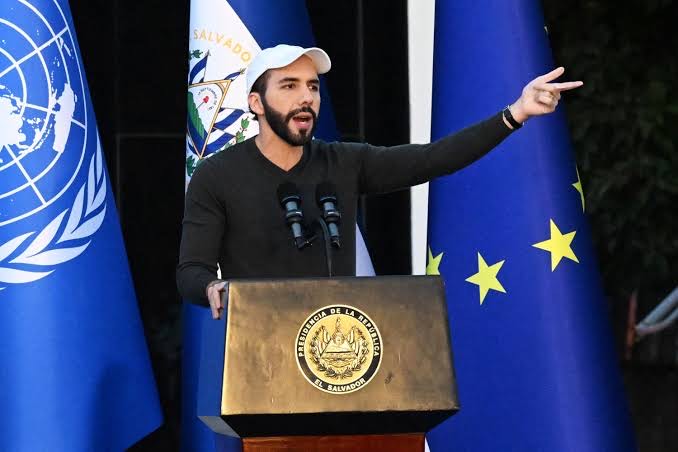
Nayib Bukele, the dictator of El Salvador, has strengthened his hold on power since taking office on June 1, 2019, at the cost of undermining democracy and the rule of law. Since the ruling party gained a majority in the Legislative Assembly at the start of this year, it has been able to adopt laws without consulting the opposition and re-organise the Constitutional Chamber, whose decisions had previously hindered the government. Bukele saw quick results from this, as the newly appointed judges quickly approved his reelection bid, even though this was clearly against the nation’s Constitution.
Nothing appears to be affecting the president’s enormous popularity at the moment, who calls himself “the world’s coolest dictator” on Twitter. This was in reality one of the arguments used to get the Chamber to agree to Bukele’s possible reelection, with the claim being that the ban on presidential turnover originated from the removal of unpopular presidents. Having said that, there has been unobserved social unrest in recent weeks that may portend shifts in popular sentiment.
How did things end up here? Here, we examine some of the most significant political and institutional advancements of the previous 24 months.
Tensions between the three branches of government over pandemic security and regulation
On June 1, 2019, Nayib Bukele emerged victorious with 53.1% of the vote, overthrowing the two major political parties that had been in control for a considerable amount of time—ARENA and FMLN. But this victory margin was out of step with the legislature’s makeup. Furthermore, Bukele had to coexist up to that point with a parliament that was largely antagonistic to the government because the Legislative Assembly was only reestablished this year.
The tension quickly eased. In spectacular events on February 9, 2020, army soldiers invaded the Assembly building in response to Bukele’s charges that parliamentarians were purposefully impeding his government’s agenda. They demanded that a credit line for the president’s crime-fighting effort be approved.
After COVID-19, controversy erupted even further, and the Assembly declined to prolong the emergency decree until May 2020. Disregarding this, the executive unilaterally issued the extension, imposing limitations on the right to assemble and travel. The administration once more disregarded the Constitutional Chamber’s declaration that the action and the linked orders were unlawful in response.
New Ideas overtakes the Assembly as the largest party, and the judiciary is overthrown
The outcome of the February 2021 legislative elections changed the dynamic between the Assembly and the Executive. With a campaign platform denouncing the unstable elements of “old politics,” the President’s New Ideas party easily prevailed. As a result, the ruling party has effectively held an outright majority in the Assembly since May 1st of this year and has been the largest Assembly party with the backing of its ally GANA.
It didn’t take long for it to start weakening institutional checks and balances after being strengthened in parliament. The judges of the Supreme Court of Justice’s Constitutional Chamber and Attorney General Raúl Melara were dismissed as soon as the new assembly members began office.
The magistrates’ actions, in upholding the presidential decrees to prolong the health emergency, were said to have been “against the Constitution, putting private interests above the health…of the entire population,” according to the reasoning. The Attorney General was removed due to his purported affiliation with the opposition ARENA party, which allegedly compromised his objectivity and independence.
The international world took notice of all of this and voiced harsh censure, including from the Vice President of the United States, the OAS, the Inter-American Commission on Human Rights, and the UN High Commissioner for Human Rights. “We are cleaning our house… and that is none of your business,” Bukele shot back.
The image has been made even more bleak by four more occurrences that followed.
First, the International Commission against Impunity in El Salvador (CICIES in Spanish), whose creation was made possible by an agreement with the OAS in September 2019, abruptly ceased operations on June 4, 2021.
Second, the Assembly passed a new Judicial Career Law on August 31st, which mandates the automatic retirement of judges who turn 60 or who have served as judges for more than 30 years. As per the local media, this development will impact over 200 magistrates, which is the equivalent of one-third of the nation’s judges.
The Attorney General’s Office Reform Law, which was enacted during the same session, then allows for the “temporary or permanent transfer of members of the prosecutorial career for justified reasons of convenience.” This has been considered as a way to get rid of judges who are thought to be against the government. It is significant to note that before to his dismissal, former Attorney General Raul Melara was looking into several claims of corruption in various ministries.
The new members of the National Council of the Judiciary (CNJ), which appoints judges before the Supreme Court of Justice and then elects the leaders of the subordinate courts in the judicial pyramid, were finally chosen by the Legislative Assembly on September 21.
Squeezing the circle: limitations on public information access
Numerous concerted efforts have been made since the middle of the previous year to compromise both the autonomy of the guarantor agency, the Institute for Access to Public Information (IAIP in Spanish), and public access to information.
By extending the president’s discretionary powers and appointing three commissioners who shared his views, Bukele changed the Law on Access to Public Information’s provisions in September 2020. A few months later, the commissioners voted to stop recording the body’s sessions.
Furthermore, Bukele issued an order in April of this year dismissing Commissioner Liduvina Escobar for “non-compliance with her duties in office and probable undertaking of acts that affect the functioning of the Institute.” Escobar has not yet been fired, but it appears that she will soon be since her attempt to contest her termination was denied.
Additionally, the Ministry of the Interior just introduced a measure on July 13th that aims to significantly alter the Law on Access to Public Information. Among these are the designation of public sector wealth statements as confidential, the development of new information-blocking measures, and the augmentation of the IAIP president’s authority to act without the consent of the other commissioners. Although the reform hasn’t been passed yet, it appears that it will be fairly soon.
What’s in store? Changes to the constitution and reelection, as well as nonviolent protests?
As we’ve seen, after gaining an extraordinary amount of authority and with two years remaining in his term, Bukele would then focus on the Constitution, which specifically forbids presidential reelection in Article 154. That seems open to interpretation, though, as Bukele was granted permission on September 3 of this year to run for a second term as president in 2024 by the newly established Constitutional Chamber. As long as the candidate for the new immediate period has taken a “leave of absence during the six months prior to the election,” it ordered the Supreme Electoral Tribunal to allow the candidature of “a person who holds the Presidency of the Republic and has not been President in the immediate previous period” (in this case, 2014–2019), defying prior precedent.
Concurrently, the administration is advocating for a constitutional amendment that would shorten the waiting period for reelection and increase the presidential term to six years. This proposal disregards Article 248, which states that provisions about the rotation of the presidential office are unchangeable. It is important to note that the proposal also calls for the creation of a Human Rights Ombudsman’s Office, the replacement of the Constitutional Chamber with a Constitutional Tribunal, and the grant of constitutional standing to the IAIP and Government Ethics Tribunal.
However, if the government has the parliamentary majority to adopt the constitutional reform in the assembly, why would it seek the support of the court? The reason for this is that should Bukele carry out this action, the reform would require the approval of two-thirds of the deputies and ratification by the upcoming Legislative Assembly, which cannot occur before 2024.
Now that democracy is being pushed to its breaking point, indications of a shift in public opinion are starting to emerge. September saw several demonstrations with the banner “For democracy and the reestablishment of the rule of law,” which had never been seen before. People demonstrated against the government’s misuse of power, the dismissal of judges, the takeover of the judiciary, and the concentration of authority around a single political person.
However, the president responded to the demonstrators by calling them terrorists and criminals, and he was especially angry with one of the members of the Association of Journalists of El Salvador’s executive committee (APES, in Spanish). The streets of the capital were overrun with police when people woke up on September 30. It remains to be seen if the government can quell these early stirrings of opposition, or if they will instead persist or perhaps pick up steam in the coming months.