






















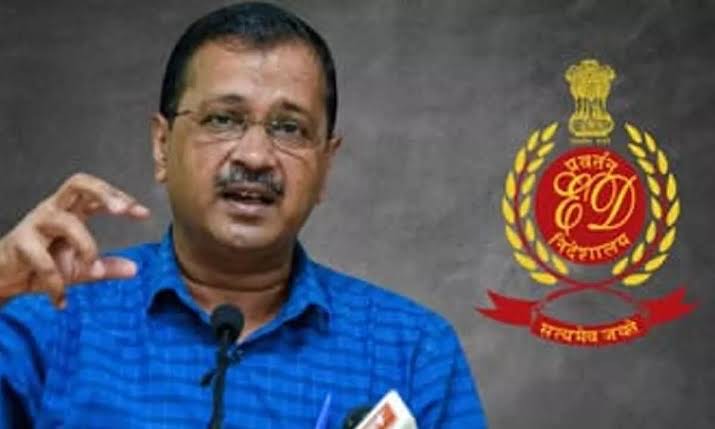
On Saturday, sources said the Enforcement Directorate (ED) has summoned Delhi chief minister Arvind Kejriwal again to appear before it on January 18 for questioning in the money laundering probe related to Delhi excise policy 2021–22 irregularities. Kejriwal dodged the ED’s third summons last week.
HT stated on January 4 that the ED would resend the summons to the chief minister, but his persistent neglect was halting their investigation.
Kejriwal said he was willing to cooperate with the ED’s third “illegal” summons but said the agency wanted to arrest him and stop him from campaigning.
The agency wants to question Kejriwal about policy design, pre-finalization discussions, and bribery. Ignoring two prior summonses on November 2 and December 22, Kejriwal called them “illegal and politically motivated.”.
ED charge sheet quote:
On December 2, 2023, the ED filed a sixth charge sheet against Sanjay Singh and Sarvesh Mishra, alleging that the AAP used ₹45 crore in policy kickbacks for their 2022 Goa assembly elections campaign.
ED has previously claimed that excise policy bribes funded the Goa assembly elections, but this is the first time it has revealed the kickbacks’ amount and named the AAP a direct beneficiary.
ED is expected to name the party in its next charge sheet based on the AAP’s direct benefits.
According to the ED, AAP leaders received payments totaling ₹100 crore related to the excise policy.
The December 2 charge sheet claims “some of the AAP leaders also personally benefited from the proceeds of crime.”. Allegedly, billionaire Dinesh Arora gave 2.2 crore to jailed AAP leader and former deputy chief minister Manish Sisodia, 1.5 lakh to former AAP communications in-charge Vijay Nair, and 2 crore to Singh.
“The PMLA (Prevention of Money Laundering Act, 2002) investigation done so far has revealed that the Delhi excise policy 2021–22 was formulated as part of a conspiracy by AAP leaders to continuously generate and channel illegal funds to themselves and the AAP,” the charge sheet adds.
In one of its five charge sheets, ED called the excise policy Kejriwal’s “brainchild.”. In remand papers, Kejriwal is accused of meetings, commissions for private players, and the introduction of southern politicians and businesses into Delhi’s spirits business.
In the excise policy probe, the financial crimes probe agency has filed six charge sheets against 31 people and businesses, including former deputy chief minister Manish Sisodia and Aam Aadmi Party Rajya Sabha member Sanjay Singh. Sisodia and Singh are in Tihar jail.
One of the six January 2023 charge sheets claims that Kejriwal told businessman Sameer Mahendru that former AAP communications in-charge Vijay Nair “is his boy” and should be trusted.
The agency alleged Sisodia’s then-secretary, C. Arvind was briefed on the 12% profit margin for wholesale private firms at Kejriwal’s residence in March 2021 in his December 2022 statement.
The charge sheet states that C. Arvind told ED that the group of ministers (GoM) of Sisodia, Satyendar Jain, and Kailash Gahlot did not consider turning over the wholesale spirits sector to private operators before mid-March 2021.
The excise policy replaced a sales-volume-based regime with a licence charge for traders to revive the city’s spirits economy. It promised swankier stores and better shopping. The policy introduced spirit discounts and incentives in Delhi for the first time.
Lieutenant Governor Vinai Kumar Saxena’s order to investigate regime anomalies prompted the policy’s cancellation. The AAP claims that Anil Baijal, Saxena’s predecessor, sabotaged the move with last-minute alterations that reduced revenues.
The ED alleges that the AAP utilised ₹100-crore Delhi excise policy kickbacks for the 2022 Goa assembly elections. The damage from excise policy anomalies is estimated at ₹2,873 crore.