





















Many people are concerned that the events in Ukraine could lead to the outbreak of World War III. As tensions between the US and Ukraine increase and the European Union supports Ukraine in its fight against Russia, this fear seems to be becoming a reality.
British Prime Minister Keir Starmer unveiled a “four-point” strategy to support Ukraine in its fight against Russia on March 2, 2025. The British prime minister announced several military and financial agreements for Ukraine following a conference with European leaders in London on Sunday.
Ironically, Britain wants to bring about peace in Ukraine. “With planes in the air and boots on the ground,” “Based on my conversations in the past few days… We’ve decided that the UK, France, and other countries will collaborate with Ukraine to develop a strategy to halt the conflict. After that, the United States and I will talk about that strategy and move it forward together. Today’s gathering was intended to bring our partners together in support of this endeavour. To make Ukraine stronger… and to encourage a fair and sustainable peace… for everyone’s benefit. We have to start with… for Ukraine to be in the best possible situation right now… so that they are in a stronger position to negotiate. At a press conference on Sunday, March 2, Starmer stated, “And we are doubling down in our support.”
British Prime Minister Keir Starmer proposed a 2.2 billion British pound ($2.8 billion) loan to Ukraine to offer military aid to Ukraine paid by blocked Russian assets, just days after US President Donald Trump publically chastised Ukrainian President Volodymyr Zelensky at the White House. In addition, the British prime minister revealed a new agreement that would enable Ukraine to buy more than 5,000 air defence missiles manufactured in Belfast, Northern Ireland, using 1.6 billion pounds ($2 billion) in export financing. PM Starmer stated that UK-made missiles would assist Ukraine in deterring Russia and creating jobs in the British defence industry, even though people are dying in the Russia-Ukraine conflict. War seems to be a business.
“I am announcing a new deal…Which allows Ukraine to use £1.6 billion of UK Export Finance…To buy more than 5,000 air defence missiles…Which will be made in Belfast…Creating jobs in our brilliant defence sector. This will be vital for protecting critical infrastructure now…And strengthening Ukraine in securing the peace when it comes. Because we have to learn from the mistakes of the past,” Starmer said, adding that there needs to be a strong deal, unlike the weak Minsk Agreements, which the Kremlin defied with ease.
As he unveiled a four-point proposal, Starmer also urged the European countries to take responsibility and share the load. This plan’s primary goal, which was determined following talks with the EU leader, is to keep giving Ukraine military assistance while also applying economic pressure on Russia. The second point stressed that to protect its security and sovereignty, Ukraine must be included in any peace agreement. To prevent further incursions by Russia, the third step is to strengthen Ukraine’s defences in the case of a peace agreement. Finally, a “coalition of the willing to defend a deal in Ukraine” would be formed, according to the British Prime Minister.
“First, we will keep the military aid flowing and continue increasing economic pressure on Russia to strengthen Ukraine now. Second, we agreed that any lasting peace must ensure Ukraine’s sovereignty and security, and Ukraine must be at the table. Third, in the event of a peace deal, we will keep boosting Ukraine’s own defensive capabilities to deter any future invasion. Fourth, we will go further to develop a coalition of the willing to defend a deal in Ukraine and to guarantee the peace,” Starmer said.
Starmer asserted that Europe must take the lead, saying, “Not every nation will feel able to contribute, but that can’t mean that we sit back.” Instead, those willing will intensify planning now with real urgency. The UK, along with others, is ready to support this initiative with both ground troops and aerial aircraft.
However, the British prime minister stressed that he shares Trump’s belief that a lasting peace is urgently needed and that such an endeavour would need substantial US support. “To keep the pace behind these actions…And to keep working towards this shared plan. Today, we stand at a critical juncture in history. This is not a moment for more talk—it is time to act….” Starmer said.
Notably, Keir Starmer and Ukrainian President Zelensky signed a “100-year partnership” pact in Kyiv in January, pledging £3 billion ($3.6 billion) in military assistance yearly in addition to financing air defence equipment and economic rehabilitation. Additionally, Keir Starmer had stated that, with broader international support, including that of the United States, he would be open to sending British troops as part of a peacekeeping mission after the ceasefire. And now, on March 3, Starmer reaffirmed his intentions for Ukraine while announcing funding for the purchase of missiles.
It should come as no surprise that the European leaders also decided that to combat Russia, they needed to spend more on defence. In keeping with this, French President Emmanuel Macron stated in an interview that European nations ought to increase their defence budgets to 3.0 to 3.5% of GDP to counter the Trump administration’s policy change in the United States and Russia’s militarisation, pointing out that the Kremlin has been allocating 10% of its GDP to defence.
However, Italian Prime Minister Giorgia Meloni denied that Italy would ever send troops to serve in a peacekeeping mission, stating that “it was never on the agenda.”
Ursula von der Leyen, president of the European Commission, declared that “re-arming Europe” was now imperative. The necessity for European nations to ensure that Ukraine has everything it needs to “stay in the fight as long as it has to continue” was again stressed by NATO General Secretary Mark Rutte.
Leaders from France, Poland, Sweden, Turkey, Norway, the Czech Republic, Denmark, Germany, the Netherlands, Romania, Finland, Italy, Spain, and Canada attended the summit on Sunday. The majority of the nations decided to form a “coalition of the willing” to support Ukraine’s defences and ensure “peace” after the conflict. The proposal of sending European forces for peacekeeping under a ceasefire was also put out by French President Emmanuel Macron.
Even if the European nations do not actively oppose Russia, their military and financial support for Ukraine has kept it fighting Russia in the conflict, which is now in its third year in 2025. However, in what they refer to as Ukraine’s defence, the European countries are now more than eager to use “troops and planes” to strike Russia. Given that the Trump administration, in contrast to its predecessor, is not particularly interested in supporting Ukraine in the struggle against Russia and escalating tensions with the Kremlin, this would provide its own set of difficulties and ramifications.
Consequences for the US and NATO: Should the UK and EU become directly involved in the conflict between Russia and Ukraine?
Given America’s military might and deterrence against the Kremlin, the UK and EU have repeatedly emphasised the need for US involvement as a backstop for any peace agreement with Ukraine, as was clear from Keir Starmer’s speech on Sunday. However, because Donald Trump has been advocating for Europe to assume greater responsibility—as demonstrated by the US’s unwillingness to provide security guarantees and demands that Europe manage Ukraine’s defenses—the situation has grown more complex. According to the Ukraine Support Tracker, the United States has contributed the most to Ukraine, giving over $119 billion, while the European Union has contributed $138 billion in financial, military, and humanitarian aid.
In the meantime, the United States has dwarfed Europe’s contributions to Ukraine with almost $65 billion since 2022, according to government data. Furthermore, Ukraine claims that the United States provides 20% of the military equipment it uses in its conflict with Russia and that it is the most capable and difficult for Europe to replace.
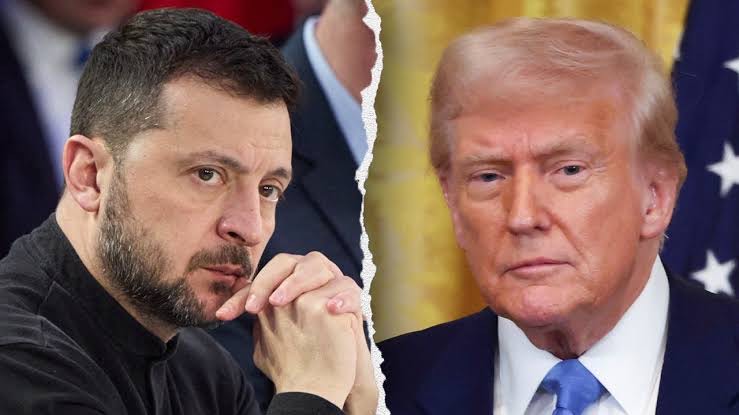
The Trump administration has now made it clear that it will cut aid to Ukraine, putting the responsibility on NATO allies like the UK and EU. With the US urging Zelensky to issue an apology or for Ukraine to nominate a new leader, the recent confrontation between Trump and Zelensky at the Oval Office has further enraged the Trump administration.
Tensions between the US and Ukraine are growing, but at the same time, Ukraine is receiving so much military and financial support from the EU that it is prepared to engage in direct war with Russia while frantically attempting to win the US over.
NATO can invoke Article 5, which requires collective defence by all NATO members if any of its member states are attacked, if European forces—for example, a coalition led by the UK and major EU countries like France, Germany, and others—enter the Russia-Ukraine war directly to “defend” Ukraine and Russia retaliates by attacking a NATO member.
“The parties agree that an armed attack against one or more of them in Europe or North America will be regarded as an attack against them all. As a result, they agree that, in the event of such an armed attack, each of them will immediately, individually, and in concert with the other parties, take whatever action it deems necessary, including the use of armed force, to restore and maintain the security of the North Atlantic area, in exercise of the right of individual or collective self-defence recognised by Article 51 of the UN Charter. The Security Council must be informed right away of any such armed attack and any subsequent actions. According to Article 5 of NATO’s founding treaty, “such measures shall be terminated when the Security Council has taken the measures necessary to restore and maintain international peace and security.”
However, attacks that take place “within a member state’s territory” are the only ones covered by Article 5. The United States will not be required to join the conflict in Ukraine by force since Ukraine has not yet been accepted to NATO. Furthermore, even in the event of an attack within a NATO nation, Article 5 does not require members to conduct acts of violence. They are free to decide how to react, which could involve using force or money.
Notably, the US would wish to leave NATO even though failure to uphold Article 5 of the organization’s founding treaty does not automatically result in expulsion. Even while it seems like a strange move, Trump 2.0 has been all about making strange and unusual choices; thus, the US may reevaluate its membership in NATO. Additionally, the US’s refusal to fight alongside NATO partners would undoubtedly damage the organization’s reputation. In addition, since the US has contributed significantly to NATO, it would be extremely difficult for the group to control its costs if the US were to leave.
Without the US, a direct invasion by the European Union and its NATO allies might spark a massive conflict in Europe that may spread to other continents. It may lead to a new round of sanctions, economic instability, boundary redrawing, the formation of new alliances, and the dissolution of NATO.
The US and Ukraine are still attempting to negotiate the desired minerals deal, nevertheless, despite the Trump-Zelensky scandal. As a strategic tool, the US-Ukraine minerals deal negotiations are still ongoing and centre on Ukraine’s rare earth reserves of cobalt, nickel, lithium, graphite, and titanium.
Large mineral reserves, including gas and oil, can be found in Ukraine. These elements and minerals are necessary for contemporary industries. The agreement will allow the United States to recover more than what it has spent on Ukraine, according to U.S. President Donald Trump. According to reports, the deal includes a jointly controlled fund that will enable Ukraine’s state-owned mineral resources to generate income for the country’s reconstruction after the war. 50% of Ukraine’s future oil, gas, and mineral deposit earnings would go towards the fund, according to the agreement. These monies would thereafter be used to finance national economic and infrastructure initiatives.
Zelensky said that if the parties agreed, the minerals deal would be ready following the London conference. This implies that the agreement is still a negotiating tool to keep US support, regardless of what transpired lately between him and Trump at the Oval Office. It may encourage Donald Trump to remain involved if it is linked to a ceasefire, which would oppose his desire for Europe to take the lead. However, it does not automatically prevent escalation unless it is linked to strong security assurances that Putin would be prepared to accept. The conflict between Russia and Ukraine might not turn into a global conflict if the US and Ukraine can reach an agreement on minerals without upsetting the Kremlin.