

























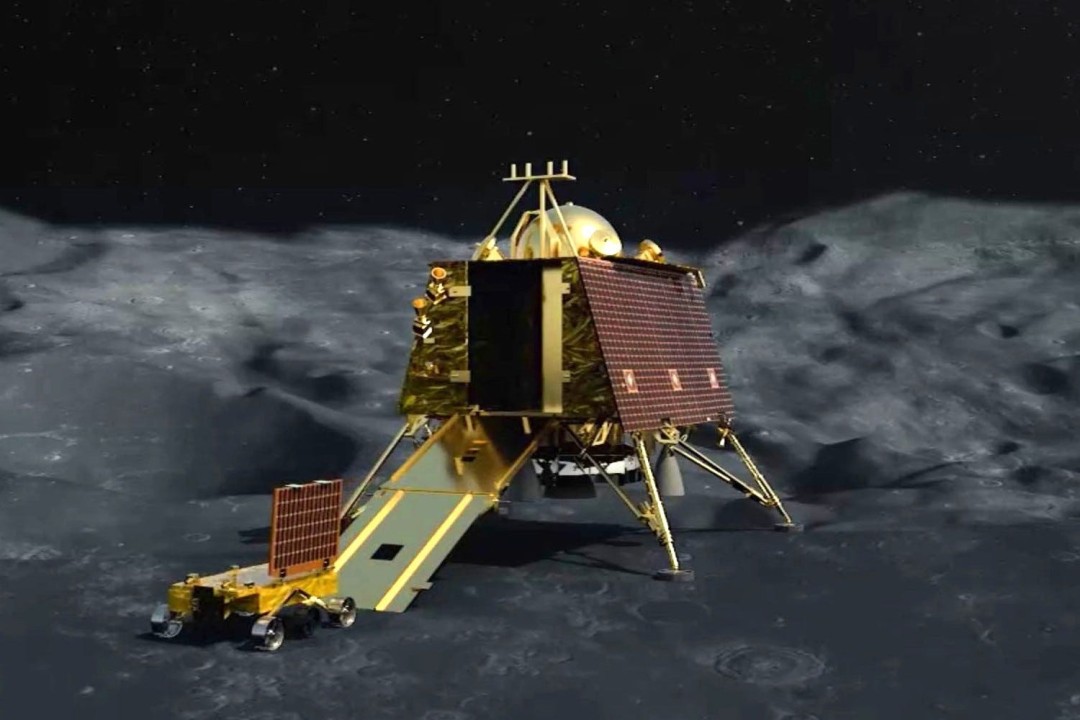
On Wednesday night, Chandrayaan-3 made a successful landing on the moon. The first image of the rover exiting the lander on the ramp was captured by the spacecraft.
Images taken by the camera aboard the Chandrayaan-3 mission’s lander “Vikram” indicated that it picked a reasonably level area of the lunar surface to land in.
These photos taken by the touchdown Imager Camera after the touchdown revealed a section of Chandrayaan-3’s landing location shortly after Vikram, with its four landing legs, had safely touched the Moon. A leg and its associated shadow are also seen, according to ISRO.
The space agency said that Chandrayaan-3 “selected a relatively flat region on the lunar surface.” Additionally, it said that a communication connection had been established between the lander and the Mission Operations Complex (MOX) of the space agency nearby. The ISRO Telemetry, Tracking and Command Network (ISTRAC) is where the MOX is situated.
India made history by becoming the first nation to go to the unexplored south pole of the planet’s only natural satellite. At around 6:04 p.m. on Wednesday, the LM, which consists of the lander (Vikram) and the rover (Pragyan), made touch down close to the south polar area of the Moon.
After touching down, the spacecraft was described by the Indian Space Research Organization (ISRO) as saying, “India, I reached my destination.”
Taking to X (formerly Twitter) to congratulate the country, ISRO wrote: “India, I reached my destination and you too!” It continued, “Chandrayaan-3 has successfully made a soft landing on the moon.”
One lunar day (or around 14 days on Earth) will be the lander and rover’s mission duration as they explore the area. ISRO representatives do not rule out the chance that they may reanimate for a subsequent lunar day, however.
CHANDRAYAAN-3
The three components of Chandrayaan-3 are a rover, a propulsion module, and an indigenous lander module. Its goals include the creation and presentation of novel technology needed for extraterrestrial missions.
According to sources, the lander will be able to release the rover, which will conduct chemical study of the lunar surface during its mobility phase, and make a gentle landing at a chosen lunar spot.
In these remote areas, scientists and astronomers believe there may be ice and significant mineral deposits. According to sources, the expedition won’t be restricted to the surface but will also concentrate on researching the exosphere and subsurface. An orbiter from Chandrayaan-2 will be used by the rover to contact Earth. Images taken from 100 km above the lunar orbit will be used to analyze the surface.