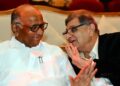




















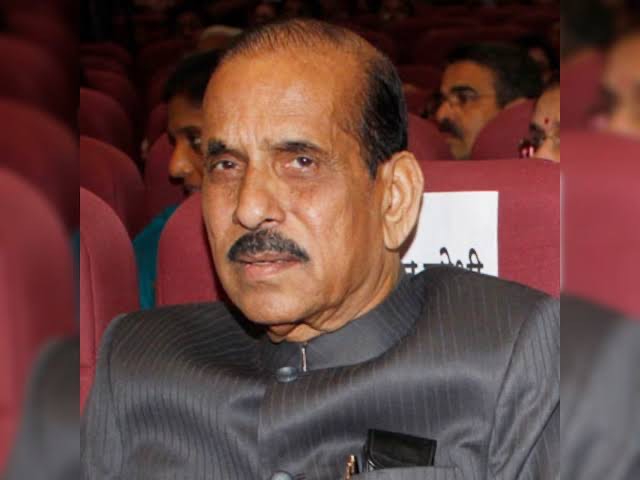
Manohar Joshi, the former chief minister of Maharashtra, passed away on Friday at around three in the morning from age-related health issues. He was eighty-six years old. P. D. Joy Chakravarty, chief operating officer of Hinduja Hospital, verified the information.
Unmesh, his son, told the Hindustan Times that his father had been brought to the intensive care unit and was being monitored. On Wednesday, he had heart problems. He suffered from chronic, age-related illnesses. The lifeless remains will be transported to our Matunga home before the final ceremonies are held at Shivaji Park Crematorium.
Joshi experienced a cerebral haemorrhage in May 2023, which put his health in jeopardy. It took him to the Indiana Hospital’s intensive care unit, where he spent several days in a semi-conscious state. He was urged to withdraw to his Shivaji Park house, where he was receiving care, since the doctors did not believe he would make a full recovery.
Joshi’s 86th birthday was commemorated on December 2nd when he was carried to his Dadar office by his followers.
Joshi, who was born in Mahad, Maharashtra, on December 2, 1937, graduated with a bachelor’s degree in civil engineering from Mumbai’s esteemed Veermata Jijabai Technological Institute (VJTI).
Joshi joined the Rashtriya Swayamsevak Sangh (RSS) at the start of his political career and afterwards joined the Shiv Sena. Joshi became a prominent Shiv Sena leader in the 1980s, renowned for his ability to organise people and establish connections at the local level.
The biggest political achievement of Manohar Joshi was his appointment as Maharashtra’s chief minister in 1995. He succeeded Indian National Congressman Sharad Pawar, bringing the Shiv Sena to power in the state for the first time. During the Vajpayee government’s tenure in the Lok Sabha from 2002 to 2004, he was also elected as a Member of Parliament.
Manohar Joshi was a complex individual who was well-known for his aptitude for management and organisation, as well as his capacity to overcome obstacles within the Shiv Sena, where adherence to founder Bal Thackeray was of utmost importance.
Joshi had emerged from abject poverty in the Raigad area of the Konkan’s Nandvi hamlet.
As a child, Joshi’s perseverance was apparent as he managed his academics while obtaining meals from his neighbours in Nandvi hamlet. Joshi used to remark that his neighbours would sometimes refuse to give him food if he arrived late for supper. His lifelong habit of being on time for meals had ingrained in him the importance of timeliness.
Joshi joined the Shiv Sena shortly after it was founded in 1966, and he and Bal Thackeray were instrumental in growing the party throughout the state. Thackeray and I would sometimes travel for days at a time. Students and staff began referring to him as “Sir” after he founded the Kohinoor Technical Institute, which focused on skill development. Eventually, all Shiv Sainiks called him by the same name.
The fight for jobs was the first step in the Shiv Sena’s quest for Marathi manoos. Joshi felt that they needed to be employed as skilled labourers as well, and his institute was very important in this.
“He contested the first BMC polls in 1986, and three corporators of Sena won,” stated Diwakar Raote, Joshi’s party comrade. He chaired a standing committee before taking office as mayor in 1976. In the 1980s, he entered state politics.
After he was elected to the state legislature, his strong ties to Mumbai and his understanding of a range of development issues enabled him to vigorously advocate for the city’s interests in the years that followed. When the Shiv Sena-BJP alliance took control of Maharashtra in 1995, Joshi was appointed chief minister.
Joshi executed Shiv Sena chief Bal Thackeray’s idea, a slum restoration programme with FSI benefits and marketable components.
“The strong understanding between Manohar Joshi and Pramod Mahajan was the reason behind the strengthening of the ties between Shiv Sena and the BJP,” recalls BJP national general secretary Vinod Tawde. After our coalition took power, the decision was made to choose Sudhir Joshi as CM, but a few hours later, the alliance chose to name his uncle, Manohar Joshi, as CM. Whenever there were disagreements between the two groups, they would frequently appease Balasaheb Thackeray and find solutions.