






















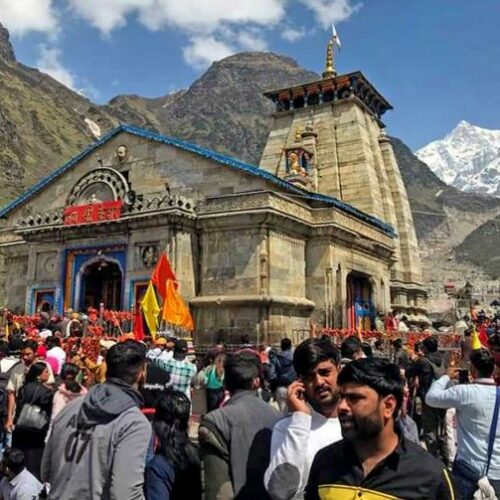
The Uttarakhand government has decided to establish a high-level committee to investigate claims after the revelation of a Rs 1.25 billion fraud involving the gold plating of the sanctum sanctorum of the Kedarnath temple.
What response is the state government giving?
Satpal Maharaj, the state’s minister of tourism, religion, and culture, gave the order to form a high-level investigation committee with the Garhwal commissioner as its head on Friday to investigate the situation.
He has requested that the investigative committee include both technical experts and goldsmiths from the office of the secretary of culture and religious affairs, Harichandra Semwal.
The issue is “extremely sensitive” to the state administration. Maharaj said that anybody found guilty would face punishment.
Regarding the gold plating fraud
According to Maharaj, a contribution was received and permission was requested from the state government to gold-plate the sanctum sanctorum of the Kedarnath temple in accordance with the terms of the Shri Badrinath-Kedarnath Temple Committee Act, 1939.
Later on, he noted that the gold plating had been carried out under the guidance of specialists from the Indian Archaeological Survey.The sanctum sanctorum walls were inlaid with gold that was purchased by a donor, with no involvement from the temple committee.
According to Maharaj, the donor sent the temple committee the work’s cost and other documentation when it was finished.
He said that the opposition parties were attempting to sabotage the Chardham Yatra by giving the issue “unnecessary” weight.
In an earlier declaration, the Badrinath-Kedarnath Temple Committee claimed that the sanctum sanctorum of the temple had 23,777.800 grammes of gold. The overall weight of the copper plates used for the gilded work was 1,001.300 kg, with a total value of Rs 29 lakh, and its estimated current worth was about Rs 14.38 crore.
In a recent video posted to social media, Teerth Purohit of the Kedarnath Temple and Santosh Trivedi, vice president of the Chardham Mahapanchayat, claimed that brass had been put on the walls of the sanctum sanctorum in place of gold plating, and that the swindle cost roughly Rs 1.25 billion.