
























One day after the Varanasi District Court made the Archaeological Survey of India (ASI) report on the Gyanvapi structure public, the Hindu reported that the study and survey of the structure “strongly suggest the existence of a substantial Hindu temple structure at the Gyanvapi mosque complex.”
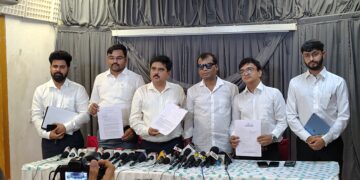
Vishnu Shankar Jain, an advocate for the Hindu faith, disclosed this information to the media while providing details about the ASI study. Notably, the court had ordered ASI to provide both the Hindu and Muslim parties with hard copies of the report.
Jain cited the following from the ASI report: “The pillars and plasters utilised in the preexisting structure underwent a methodical and scientific investigation.” Regarding the expansion of the mosque and the construction of the sahn, minor alterations were made to portions of the preexisting temple, such as pillars and plasters. Jain explained that this signifies the utilisation of pillars from a pre-existing Hindu temple in the fabrication of the mosque.
The report goes on to say that the stones and pillars’ engravings clearly indicate that they were previously a part of a Hindu temple that was destroyed to build the mosque. According to ASI, a quick examination of the pillars and pilasters in the passageway indicates that they were formerly a part of the earlier Hindu temple.
The TNG Times obtained pertinent sections from the report and found that, prior to the current structure’s construction, a sizable Hindu temple could have existed. According to the study, vyala figures that were carved on either side of the lotus medallion were destroyed in order to repurpose the pillars in the existing construction. Then, the area was embellished with floral patterns after the stone mass from the corners was removed. Two comparable plasters that are still in their original locations on the northern and southern walls of the western chamber attest to this observation.

Entryway and central chamber
The report mentioned several pre-existing structures, such as the Western chamber and wall, the Central chamber and main entrance of the pre-existing structure, the Arabic and Persian inscriptions on the loose stone, the inscriptions on the existing structure, the sculpture remnants in the cellars, and the reuse of pillars and plasters of the pre-existing structure in the existing structure.
The Hindu temple has a large central room as well as at least one chamber to each of the north, south, east, and west, according to the ASI study. Three chambers to the south and west still have remnants, but the east chamber’s remnants and any extension could not be physically determined because the region is covered by a stone platform.
According to this, the centre hall of the current structure is formed by the central chamber of the pre-existing structure. The mosque’s main hall was housed in this building, which had sturdy walls, architectural elements, and floral decorations. The interior of the dome is covered with geometric patterns, but the animal figurines that were carved at the lower extremities of the pre-existing structure’s decorative arches were disfigured.
According to the story, the main entrance to the temple’s central chamber was on the west side, but stone construction blocked it. Animal and bird carvings, as well as an ornate torana, adorned this entrance. There was another smaller entry to this grand, arched gateway. The figure carved on this little entrance’s lalatbimba has been cut off. Only a small portion of it is visible since the entrance was blocked by bricks, stone, and mortar covering the majority of it.
Regarding the Western wall of the extant structure, which was evidently a component of a Hindu temple, the ASI study notes that the superstructure of the Western half has been damaged, while the Eastern half of the Western chamber remains intact. Additionally, a passageway that was reachable from the north and south entrances of this chamber connected it to the north and south chambers. The northwest side’s remnants of this corridor were discovered after trash and debris were cleared up.
The western wall of the current edifice is the residual remnant of a pre-existing Hindu temple, as the ASI study definitely asserts. The remnants of the western chamber, the western projections of the central room, and the western walls of the two chambers to its north and south combine to produce this stone wall embellished with horizontal mouldings. According to the report, the two side chambers have undergone alterations, but the central chamber that is fixed to the wall remains the same.
There were openings in each of these four chamber directions. The westward-facing arched portals to the central, north, and south chambers are blocked. The arched entrances of the north and south halls were turned into steps leading to the roof. There are still steps leading up to the north hall’s arched entrance. At a later time, stone masonry covered the steps leading to the south hall’s arched entrance, but access is still possible through the roof.
Inscriptions
The ASI report also provides information about the instructions discovered within the building, which attest to the presence of a Hindu temple. Numerous inscriptions on both the pre-existing and current structures were discovered throughout the survey. 32 estampages and 34 inscriptions in total were taken during the current survey. In actuality, these are inscriptions that were formerly present on the stones of Hindu temples that were reused for building or restoration projects. According to ASI, they have inscriptions in the Grantha, Telugu, Kannada, and Devanagari scripts.
According to ASI, the repurposing of older inscriptions within the structure implies that the previous constructions were demolished and their components were repurposed for the building or restoration of the current structure. These inscriptions contain three names of deities, including Janardhana, Rudra, and UmeSvara.
According to ASI, there is significance to phrases like Maha-muktimarfapa, which are mentioned in three different inscriptions.
Regarding the inscription on the loose stone discovered inside the building, ASI stated that it records the building of the mosque during the 20th regnal year of Mughal Emperor Aurangzeb, or 1676–1677. This inscription further said that sahan, etc., was used to rebuild the mosque in the years 1792–1793 CE.
As per the findings of ASI, the inscriptions on the loose stones correspond with the details found in Maasir-i-Alamgiri, the biography of Emperor Aurangzeb. The biography states that Aurangzeb gave orders to the governors of all the provinces to destroy the temples and schools belonging to the unbelievers (Jadu-Nath Sarkar (tr.) 1947, Maasir-i-Alamgiri, pp. 51–52). “According to the Emperor’s command, his officers had demolished the temple of Viswanath at Kashi,” the ASI reports on September 2, 1669.
investigation of vaults
The report goes on to say that in order to accommodate a large number of people for prayers, a series of cellars were also built to the east to create additional space and a large platform in front of the mosque. It claims that the vaults in the eastern portion of the platform were constructed using pillars from former temples. In cellar N2, a bell-adorned pillar with four lamp niches and an inscription reading Sarhvat 1669 (which corresponds to Friday, January 1, 1613 CE) is repurposed.
In cellar S2, the ASI study states that sculptures of Hindu deities and carved architectural elements were discovered buried beneath the deposited soil.
Age and Nature
The existing architectural remains, decorated mouldings on the walls, karna-ratha and prati-ratha of the central chamber, a large decorated entrance gate with torana on the eastern wall of the western chamber, a small entrance with a mutilated image on lalatbimba, and animals and birds carved for decoration both inside and outside suggest that the western wall is the remaining portion of a Hindu temple, according to ASI, who was discussing the nature of the earlier structure. It states unequivocally that this pre-existing monument may be recognised as a Hindu temple based on its art and architecture.
A room was discovered with an Arabic-Persian inscription stating that the mosque was constructed during the 20th year of Aurangzeb’s reign (1676–77 CE). As a result, according to the ASI assessment, the previous construction appears to have been destroyed in the 17th century, during the reign of Aurangzeb, and some of its components were altered and utilised in the current structure.
The report’s conclusion states that it is possible to conclude that there was a Hindu temple before the current building was built based on scientific research and surveys, an examination of architectural remnants, exposed features and artefacts, inscriptions, artwork, and sculptures.