























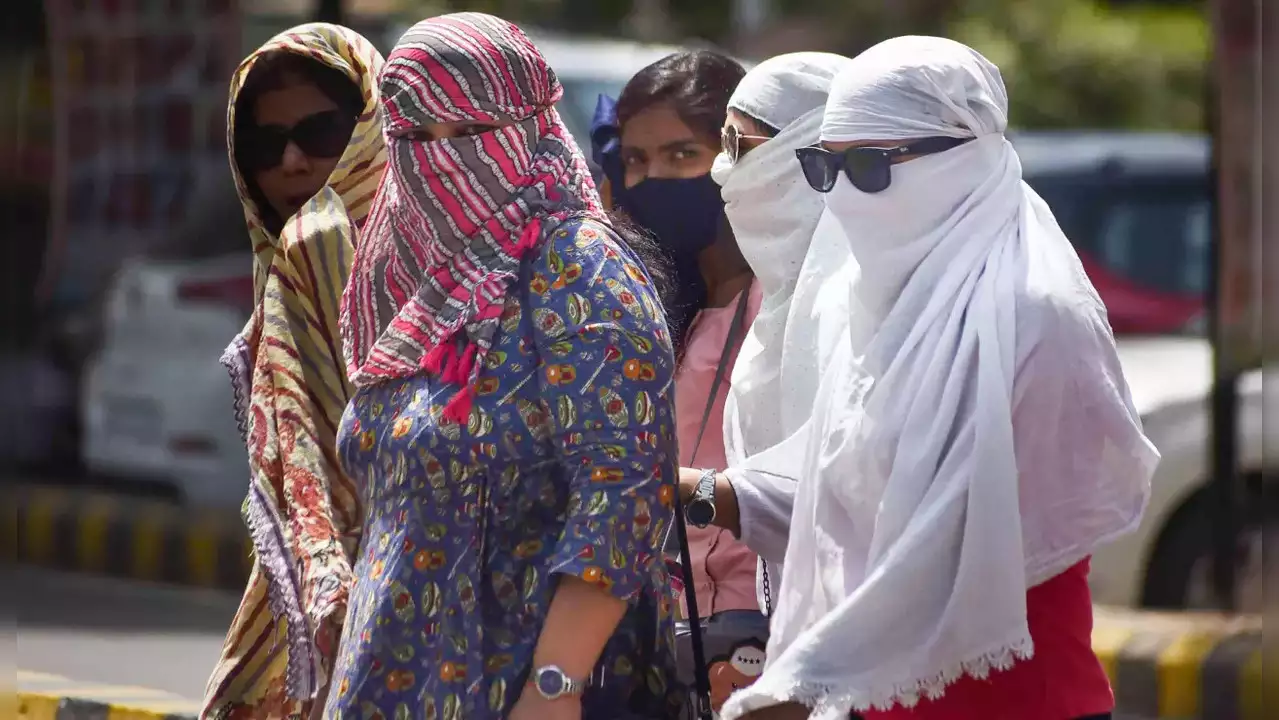
For the next 48 hours (Sunday and Monday), the India Meteorological Department (IMD) has issued a heatwave warning for 18 districts in Uttar Pradesh, according to an IMD official.
The IMD predicted that these locations’ daytime temperatures will rise over 40 degrees Celsius.
Following that, it will begin to rain in remote areas of east and west Uttar Pradesh on Tuesday evening and last for five days.
Banda, Chitrakoot, Kaushambi, Prayagraj, Fatehpur, Sonbhadra, Mirzapur, Mathura, Agra, Firozabad, Etawah, Auraiya, Jalaun, Hamirpur, Mahoba, Jhansi, Lalitpur, and the surrounding regions are the districts that would be affected by the heatwave.
Mohd Danish, the head of the Lucknow Met office, said that 12 out of the 18 districts stated above experienced a heat wave on Saturday as well.
These 18 districts are under a yellow warning from the IMD.
Green (no action required), yellow (watch and remain informed), orange (be prepared), and red (take action) are the four color designations used by the IMD for weather warnings.
When the highest temperature reaches 40 degrees Celsius or more, or stays 4.5 degrees above average for two days straight, a heatwave is said to have occurred. On Saturday, the daytime temperature in parts of Uttar Pradesh increased by 3.5 degrees Celsius.
The daytime high in Jhansi was 45.1 degrees Celsius, followed by Prayagraj (44.8), Agra (43) and Varanasi (BHU) (43) and Kanpur (42.3), Lakhimpur Kheri (42) and Fursatganj (42).
The highest and lowest recorded temperatures in Lucknow were 40.1 and 24.4 degrees Celsius, respectively. The state capital is expected to have mostly clear skies.
When the state’s majority of schools, including government elementary and upper primary schools, are out of session for the summer, a heatwave warning is issued.
India experiences the monsoon around June 1. Between June 18 and June 20, it travels through eastern regions like Ballia and Gorakhpur before arriving in Uttar Pradesh.
Going outside between midday and 4.30 p.m., when the daytime temperature is at the maximum, should be avoided if at all possible, according to physicians, since the heat offers a serious health risk.
According to N.S. Verma, senior professor at King George’s Medical University (KGMU), “Try to keep outdoor work limited in these hours at least until the monsoon hits the region and humidity levels go up and the temperature falls a little.”
The previous president of the Indian Medical Association’s Lucknow division, P.K. Gupta, said, “Make sure you drink water often throughout the day. Drink extra water before leaving the home, wear a helmet if you’re riding a bike, and cover your head with a hat or cotton cloth if you’re using public transportation. Use the air conditioning only at the very end of your trip if you are traveling by automobile.
Keep the vehicle’s air conditioning on low to ensure there isn’t a significant variation in temperature between the exterior (of the car) and the inside, said Abhishek Shukla, a geriatric medicine specialist and the director of Aastha Hospice. A minute before arriving at the location, turn off the AC and open the window. Avoid running the air conditioning on maximum setting if there are senior passengers in the vehicle since it might swiftly change their body temperature.