





















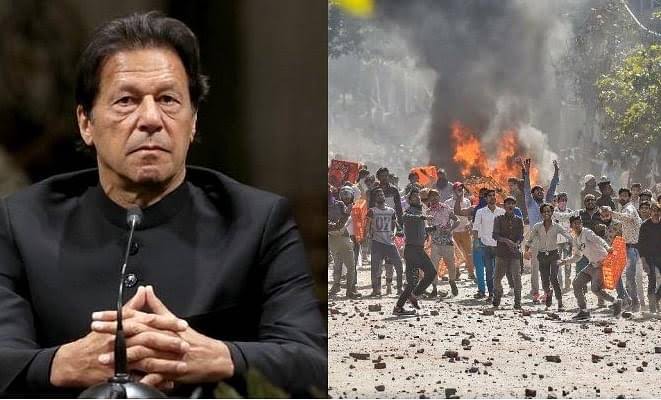
Pakistan has been built on the blood and death of many innocents. The beginning of the country itself has had a foundation of bloodshed and violence. Killing and fighting is not anything new for Pakistan but what is new for the country is losing its complete grip. It has become a living hell there. Every politician in Pakistan degraded the country piece by piece since decades. Like every human. being, every country also has a Karma based on the history and the intentions of its people. And Karma never forgets an address.
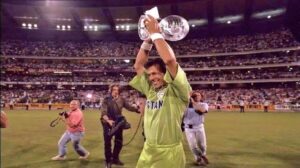
Mr Khan, 70, who was raised in an affluent household in Lahore and graduated from Oxford University, first achieved worldwide success on the cricket pitch in the late 1970s. He wed Jemima Goldsmith, a British heiress, in 1995. After leading Pakistan to its sole World Cup victory in 1992, Mr Khan attempted to use his cricketing fame to launch a political career by founding his party, Pakistan Tehreek-e-Insaf, or the Movement for Justice. In his political career, he presented himself as a reformer who offered a rival to Pakistan’s powerful political families.
Mr Khan battled for more than ten years to get political traction and endured mockery for his aspirations. In 2011, he started to gain political traction and drew huge crowds of Pakistanis to his rallies. His populist, anti-corruption, and anti-American stance inspired a lot of people. By that time, Mr Khan had converted to a devout branch of Islam and was working to improve his public image. Mr Khan married Bushra Bibi, his spiritual advisor, for a third time in 2018. After divorcing Ms Goldsmith, he temporarily wed radio journalist Reham Khan in 2015. His marriage to Ms Goldsmith had also ended in divorce. 2018 saw the election of Mr Khan as prime minister after gaining the support of military authorities. Many of his challengers claimed that the military rigged the election in his favour; both Mr Khan and the military have refuted this claim. He introduced a new approach to foreign policy, one that put Russia and China ahead of the United States.
The relatively peaceful term of Mr. Khan started to come to an end in 2021 as anger over his handling of the economy reached a boiling point and it looked that a disagreement with the military over its leadership had cost him its support. In April of last year, a parliamentary no-confidence vote resulted in his resignation from his position. Tensions increased after a guy opened fire on his convoy during a political event in November, leaving him wounded. Aides described it as an attempt at assassination. Since being ousted from office, Mr Khan has been accused of several offences, including terrorism and corruption. He has also been threatened with incarceration on numerous occasions for missing court appearances. Additionally, he has publicly criticised the military and administration, claiming they are working against him.
On Tuesday, Mr Khan was detained on suspicion of corruption in a case involving the transfer of land for Al-Qadir University, close to Islamabad. A real estate magnate named Malik Riaz Hussain has been accused of receiving favours from Mr Khan in exchange for the university receiving donations and property.
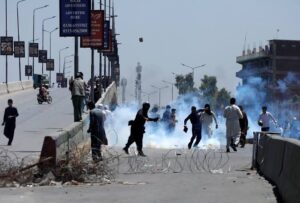
The political crisis in Pakistan has worsened ahead of national elections later this year after Imran Khan, the country’s former prime minister, was detained by paramilitary forces on corruption charges on Tuesday. Khan, who claims the accusations are politically motivated since he is running for reelection in Pakistan’s capital Islamabad, was taken into custody by troops who had invaded a courthouse. As prime minister, he is accused by Pakistani authorities of unlawfully purchasing land from a business mogul, costing the nation’s coffers hundreds of millions of dollars. Khan called for demonstrations in response to his detention, and a large contingent of his followers responded by appearing at the residences of the corps commander in Lahore and the army general headquarters in Rawalpindi.
Khan’s detention exacerbates several crises that are currently endangering Pakistan’s stability. The nation is currently experiencing record-high inflation and is in danger of becoming bankrupt. Additionally, recent terrorist activity has increased. However, the political turmoil has so far eclipsed these problems and, according to experts, might trigger widespread protests. “Khan has a sizable, fervent, and expanding fan base who have long seen his arrest as a red line. According to Michael Kugelman, director of the Wilson Center’s South Asia Institute, his followers have already taken to the streets and are expected to remain there for some time. “The likelihood of protracted unrest in urban centres increases the longer Khan is detained,”
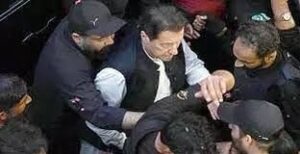
After falling out of favour with the political establishment and Pakistan’s military, Khan, the populist leader of Pakistan Tehreek-e-Insaf (PTI), one of the biggest political parties in the nation, became the first prime minister in the nation’s history to be overthrown in an April 2022 vote of no confidence. He was ousted on the basis that he had fallen short of his campaign promises to eradicate corruption and revive the nation’s struggling economy. The ex-cricketer, though, is also a charismatic leader who has garnered support since being ousted by capitalising on public resentment against official brutality and corruption. Although his fans have been demonstrating for months, their indignation has grown as more accusations against him have surfaced. More than 100 cases currently have him as their target.
Tamanna Salikuddin, South Asia director for the US Institute of Peace, remarked that the nation is concentrating on this political turmoil and the political instability rather than those issues. “At this point, you are even more helpless to address the economic and terrorism challenges. There won’t be any room for anyone to cope with them. The most recent accusations against Khan are in addition to several older ones, including terrorist and blasphemy accusations. Although Khan’s guilt or innocence has not yet been proven in court, political experts point out that even if he is guilty, the accusations may be politically driven.
Salikuddin stated, “I don’t want to imply in any way that there could not be something there to hold him accountable for corruption. “Having said that, you could accuse practically every politician in Pakistan of corruption. Additionally, these situations typically don’t surface until there is a clear political motive. Khan’s goal might be to subdue an outspoken opponent of the existing administration. He has accused the military of being responsible for an attack at a rally in November that left him shot and injured; the military has vigorously disputed these accusations. In Pakistani politics, the military plays a significant role. Civilian politicians frequently court the military’s favour and solicit its assistance with concerns of national security. In addition, he claims that the current administration is working with the military to depose him.
While a corruption case is an immediate reason for the arrest, Kugelman claimed that Khan and the civilian and military leadership have likely been locked in vengeance for more than a year, ever before he was ousted. He has been at the centre of corruption scandals and has used severe measures to hold onto power, therefore he may be the target of an opposition campaign. A vast corruption operation involving offshore corporations and trusts that members of his inner circle used to conceal millions of dollars in wealth was reportedly perpetrated by them, and he attempted to dissolve parliament to escape the no-confidence vote. His anti-corruption initiatives (while mainly justified) nevertheless prevented the government from doing normal business.
Khan was prevented from taking office until the end of the current Pakistani National Assembly session in August by a prior court decision. That implies, even while his incarceration will prevent him from physically campaigning for the time being, he would likely be free to compete for reelection as prime minister in the autumn. But that also relies on if the current administration is successful in proving that he should be barred from re-running for public office as a result of the corruption allegations. With Khan’s arrest, Pakistan’s political situation has now reached a tipping point where there may be no turning back. The country is reportedly experiencing its worst crisis since East Pakistan formed Bangladesh in 1971, according to some experts.
Potentially at risk is Pakistan’s democratic system. Beginning in 2008, Pakistan had a democratic consolidation following decades of military dictatorship. However, there are now worries that political discontent can trigger a violent, anti-democratic action, such as a military takeover. According to Madiha Afzal, a foreign policy fellow at the Brookings Institution, “It’s difficult to see how the political situation deescalates now; this is a very dangerous development and dashes any hopes for Pakistan’s political stability. “According to Kugelman, the government can exploit protracted unrest as a justification to postpone the scheduled national elections for October. It may, however, “backfire because the unrest would likely intensify in reaction to a decision to postpone polls,” he added. In addition, it’s unclear whether Khan’s supporters will accept the election results if he loses or is disqualified. Would his supporters acknowledge the accuracy of the election results? Would they show up to protest in the streets? That situation, in my opinion, is highly likely, Salikuddin stated.
Nobody can fight the fate. We sow and that’s what we reap. Its all here and now. This is a sure debacle. For Imran Khan and for Pakistan both.