




















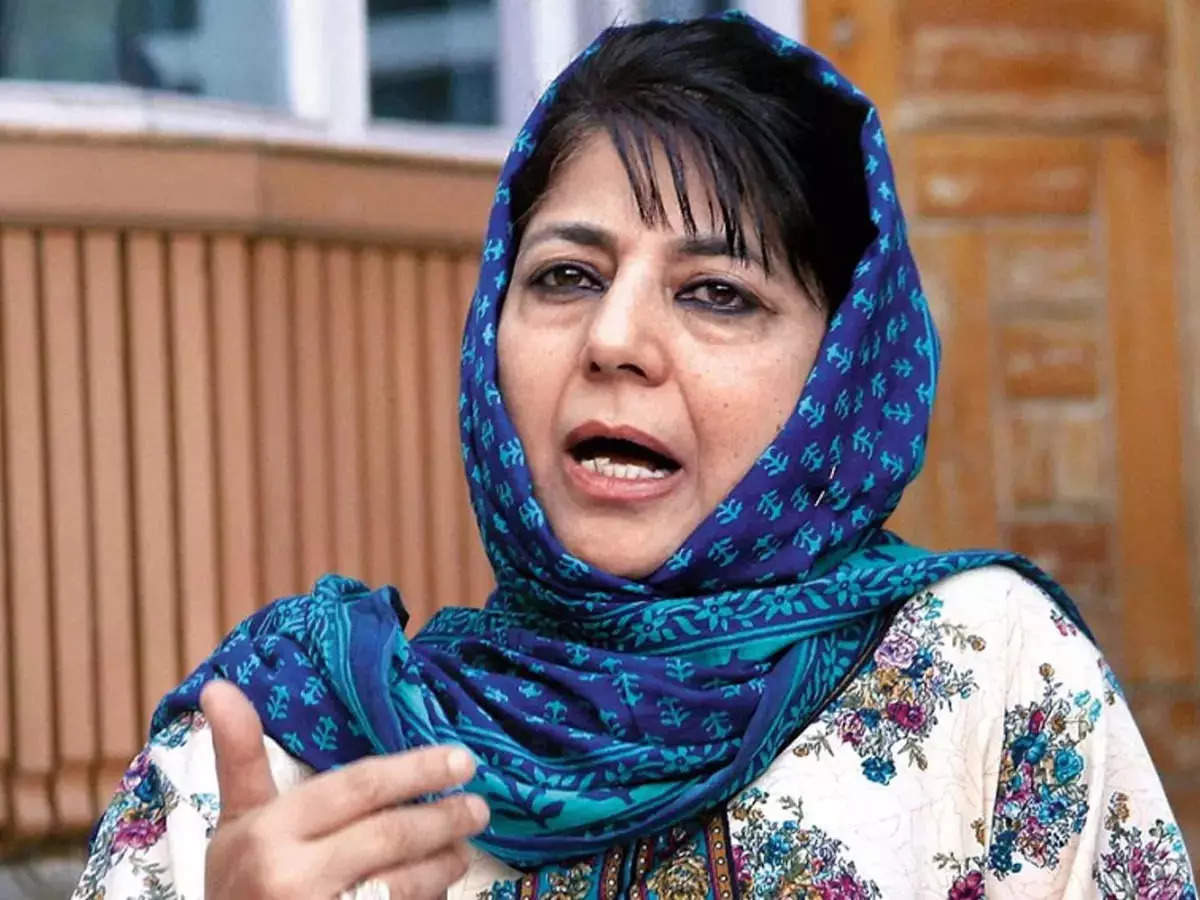
Mehbooba Mufti, a former chief minister of Jammu and Kashmir, and Manoj Sinha, the current lieutenant governor of J&K, discussed the repeal of Articles 370 and 35A when Chief Justice DY Chandrachud was in Srinagar.
Sinha referred to the 2019 decision made by the Narendra Modi administration as “historic reforms,” while Mehbooba drew attention to the legal difficulties that the decision is now facing before the Supreme Court.
The Modi administration removed J&K’s special status and repealed Articles 370 and 35A of the Indian Constitution on August 5, 2019. Additionally, the state was divided into the J&K and Ladakh Union Territories (UTs).
On Friday, Chandrachud travelled to Srinagar to give the opening speech at the 19th All India Legal Services Authorities’ Meet.
Mehbooba Mufti said what?
Mehbooba Mufti, a former chief minister of J&K, brought up the matters that have been pending before the Supreme Court for the previous four years challenging the repeal of Article 370.
Mehbooba also drew Chandrachud’s attention to the “thousands of youths” awaiting trial in prisons.
“Welcome CJI to Kashmir,” she tweeted. It was unlawful to rescind Article 370, a constitutional guarantee made by this country to the people of J&K. This is true notwithstanding prior decisions by the Supreme Court opposing its repeal. The issue has been on the Honourable Court’s docket for four years.
“Thousands of our children suffer in prison without access to a trial. The penalty is now the procedure itself.
J&K joined India voluntarily, not under duress. So why is it denied the essential rights and protections outlined in the Constitution itself? I really hope that your presence sheds some light on these crucial topics.
Chandrachud praises authorities on legal help
CJI Chandrachud thanked NALSA and the J&K Legal Services Authority for convening the meeting and bringing together the depth of knowledge and expertise of the Indian Judiciary in his speech.
“This significant meeting is the reflection of mainstreaming of J&K and Ladakh in the discourse of development in India,” he remarked, speaking from the viewpoint of the Indian judiciary.
“Our Constitution aims to establish a social structure based on social justice, equality, and liberty. No matter their social or economic level, every person has basic rights established by the Indian Constitution.
Less than 8% of those who are awaiting trial make advantage of the legal assistance to which they are entitled, according to Chandrachud.
“We must redesign the rules. The laws governing summons delivery on horses were established at that time. In the times we live in, the laws are no longer applicable. We need to make them more applicable and adaptable, whether it’s via our civil or criminal guidelines, Chandrachud added.
J&K LG Sinha applauds the repeal of Article 370
Speaking during the meeting, J&K LG Manoj Sinha praised the efforts made by the legal services authority to fulfil the constitutional mandate set out in Article 39(A), which calls for the provision of free legal assistance to the most vulnerable members of society, as well as the promotion of social justice and equality.
When discussing the repeal of Article 370, Sinha said that for almost seven decades, J&K has been unable to gain much from central law because of this provision.
“It had also denied a significant portion of society the privileges of legal citizenship. Article 370’s repeal promoted social equality and inclusive growth, according to Sinha.
According to Sinha, the repeal of Articles 370 and 35A ushered in a new era in J&K and historic changes.
In his words, “Today, the UT is offering limitless possibilities to the people, especially to those from the weaker section of society, who were deprived of the benefits of the laws enacted by the Parliament.”
After Article 370 is repealed, according to Sinha, J&K will be associated with peace, development, and prosperity within four years.
He stated, “During the G20 conference last month, the world saw our capacity and socioeconomic progress. Infrastructure development has reached a new level as projects are carried out at a pace never before seen.
To give farmers and landowners more control, outdated land regulations were repealed, and land passbooks were published in three different languages. The advantages of growth are felt by all groups, and places that suffered from uneven progress have been integrated into the mainstream of development thanks to transparent and responsible government.
The petitions opposing the repeal of Article 370
The Supreme Court has been hearing applications since 2019 that contest the repeal of Article 370 on August 5, 2019.
The bench made up of CJI Chandrachud and Justice PS Narasimha agreed to review a list of arguments on December 22, 2022, but since then, nothing has changed.
The federal government is not interested in hearing the issue, according to the petitioners, who are mostly major political groups. According to the former chief minister Omar Abdullah, the BJP administration does not want the Supreme Court to consider cases contesting the legality of revoking Article 370 because “it would be impossible for it to defend abrogation of Article 370.”