






















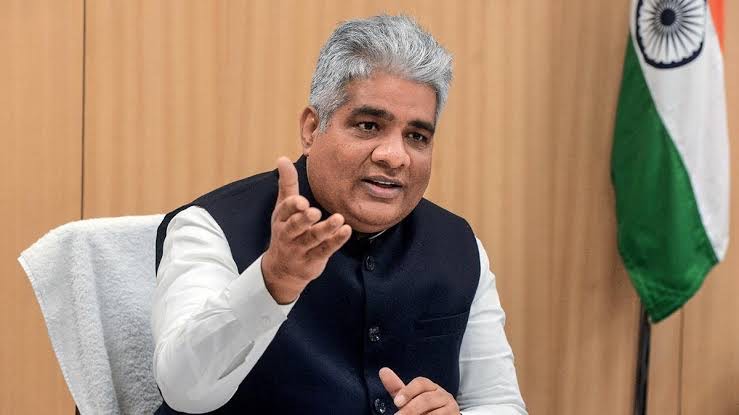
According to Union Minister for the Environment, Forests, and Climate Change Bhupender Yadav, obtaining inexpensive energy is essential to ensuring that everyone in India has the wherewithal to live with dignity.
“Young people should strive to fulfil the Paris Agreement’s objectives as well as sustainable development goals.” Climate justice must be upheld while we confront climate change. In India, everyone needs to have access to the resources needed to live in dignity. During his opening speech at the World Sustainable Development Summit (WSDS) on Wednesday, he stated, “We believe that everyone has the right to inexpensive and environmentally friendly energy.
India is quickly moving towards renewable energy. India has added almost 100 GW of installed electric capacity between 2017 and 2023, of which 80% comes from non-fossil fuel-based sources, according to Yadav. The country has also updated its nationally determined contribution (NDC), demonstrating a strong commitment to stepping up climate action.
Two of our climate goals for 2015 have already been met. First, a 33% decrease in GDP’s emission intensity between 2005 and 2019 was accomplished 11 years ahead of schedule. Second, nine years ahead of schedule, we have reached 44% of installed electric capacity from non-fossil fuel sources,” Yadav stated at the Energy and Resources Institute (TERI) summit.
During his speech to WSDS earlier in the day, Mukhtar Babayev, the president of COP29 and the Republic of Azerbaijan’s minister of ecology and natural resources, stated that developing countries will require almost USD 6 trillion by 2030 to combat and adapt to climate change.
Our goal is to provide a precise, doable road map that outlines how to double energy efficiency and triple energy capacity. In order to turn lofty goals into attainable realities, he continued, “I am committed to obtaining a strong commitment from nations and stakeholders.”
Our resolute faith in the ability of global cooperation to tackle intricate problems led us to choose to host COP29. We acknowledge how intertwined the problems caused by climate change are, and we sincerely think that through promoting global cooperation and communication, we can all work together to find effective answers,” Babayev continued.
Prof. Hoesung Lee, a former head of the Intergovernmental Panel on Climate Change (IPCC), discussed the goal of keeping warming to 1.5°C.
“The global stocktake from the previous year made evident how little progress we have made to keep global warming to 1.5 degrees Celsius. Although gaps in policy, ambition, implementation, financing, and technology are common, the economic potential that results from addressing these gaps is genuinely unexpected. According to recent studies, by 2015, adopting extra measures might result in a net economic benefit equivalent to 7% of the global GDP, the speaker stated.
Additionally, Vice President Jagdeep Dhankhar clarified India’s goal of being carbon neutral by 2070.
This is a good step in the right direction, as India aims to become carbon neutral by 2070 and is increasing the usage of biofuel in its transportation sector. There is an unprecedented upsurge in support for electric automobiles. In the genuine spirit of sustainability, there is a growing emphasis on the circular economy, he stated.