























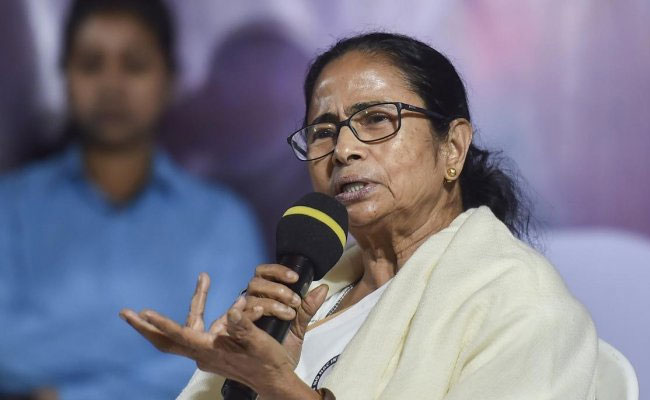
Mamata Banerjee was accused of insulting the national anthem during an event here, but the Bombay High Court declined to take any action against her on Wednesday, stating that it was unnecessary to become involved in the situation.
Banerjee’s request to overturn a judgment of the Sessions Court from January 2023 sending the case back to the magistrate’s court for investigation and on the question of summons issuing was denied by a single bench of Judge Amit Borkar.
Banerjee claimed in her motion that the sessions court should have invalidated the whole complaint rather than only the summons and remitted the case.
The high court ruled that there was no error in the sessions court’s decision to send the case back to the magistrate’s court for a further investigation and decision on the issuing of process (summons). So, the HC does not need to intervene, according to Judge Borkar.
The magistrate’s court had disregarded the requirements of sections 200 and 202 of the Code of Criminal Procedure, according to the sessions court, which annulled the summons and sent the case back.
In accordance with these provisions, a magistrate may defer the issuing of a summons in a case, conduct an investigation independently, or order the police station in question when the individual against whom action is sought lives beyond the magistrate’s geographical authority.
An investigation under these laws, according to Banerjee’s attorney Majeed Memon, would unnecessarily harass and disgrace the CM, a public servant.
Nevertheless, Judge Borkar declined to accept this claim, stating that the goal of an investigation conducted in accordance with Sections 200 and 202 is to determine if there is enough evidence to proceed against the accused.
“Order to conduct such an investigation does not harm the accused in any way. The magistrate is required to issue an order in conformity with the law if it is ultimately determined after conducting such an investigation that there is no case to be made out.
Judge Borkar also rejected Memon’s claim that the elements of section 3 of the Prevention of Insults to National Honour Act (which prohibits creating disturbances while singing the national anthem) were not established in this particular instance.
“The petitioner (Banerjee) misconstrued the order from the sessions court. According to Judge Borkar, the Sessions Court has not reached a decision that the offense described in Section 3 is not present.
The sessions court had simply said that the magistrate was not justified in issuing process (summons) on the grounds that an investigation under sections 200 and 202 had not been completed, the high court noted.
The court cited a Supreme Court ruling that said it was improper for a sessions court conducting a review to analyze the whole of the case on its merits and then reject it on those grounds.
The sole grounds for faulting the order of process issuance were sections 200 and 202. There can be no fault identified since, in my judgment, the sessions judge’s decision to not rule on the merits and send the case back to the magistrate’s court was in accordance with the SC ruling.
Therefore there is no need for intervention, the court dismissed the application.
The bench also ruled that the accused has no right to take part in the proceedings before the magistrate until the court issues a summons, which is a well-established legal principle.
On the basis of a complaint made by Vivekanand Gupta, a magistrate’s court summoned Banerjee in March of last year. Vivekanand Gupta claimed that during a public event at Mumbai’s Yashwantrao Chavan Auditorium at Cuffe Parade, Banerjee began singing the National Anthem while seated, later stood up and sang two verses of the anthem, then abruptly stopped and left the location.
The summons had been contested by the chief minister before the special court.
On procedural grounds, special judge R N Rokade overturned the magistrate’s summons in January 2023 and requested that the magistrate reexamine the case.
Banerjee, who is also the founding chairwoman of the All India Trinamool Party, disputed this ruling in her case to the High Court by arguing that the summons should have been annulled rather than telling the judge to look into it again.
According to Gupta’s complaint, Banerjee’s action violated the Prevention of Insults to National Honour Act of 1971 since it disrespected and insulted the national anthem.
Gupta initially complained to the police at the Cuffe Parade station, and when they didn’t do anything about it, he complained to the Metropolitan Magistrate.