



















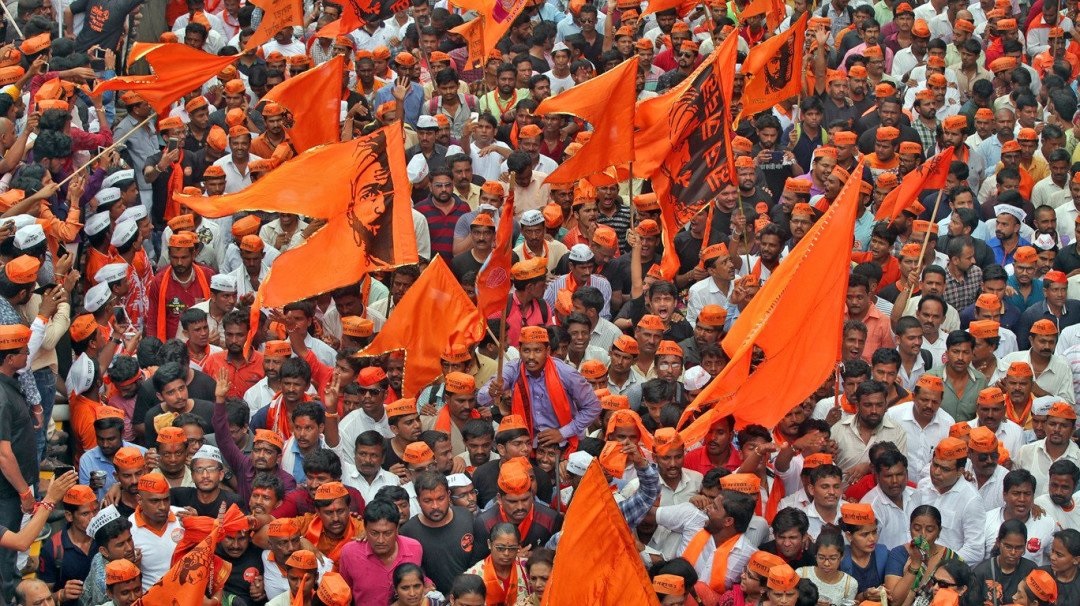
With 6000 villages proposing a boycott of Maharashtra Cabinet ministers and party leaders across political divides, the Maratha reservation movement in Maharashtra has gained strong momentum. This appeal is in favor of Maratha politician Manoj Jarange-Patil’s current hunger strike in Jalna.
Maratha village residents are demolishing and setting on fire political party flags and hoardings. Other Maharashtran villages are starting to hear the demand for a boycott. Relay hunger strikes have begun in approximately 6000 villages in support of Jarange-Patil, who had given the Maharashtra government till October 24 to provide reservations for the Maratha population in employment and educational institutions.
In order to find a solution to the Maratha reservation dispute, Chief Minister Eknath Shinde and Deputy Chief Minister Devendra Fadnavis hurried to Delhi for a meeting with the top BJP leadership. The Maharashtra Assembly and Lok Sabha elections are scheduled for the next year, therefore the state administration is under pressure to fulfill Jarange-Patil’s requests as soon as possible.
In addition, he had asked that the charges against the Maratha community members be dropped within two days of his September 14 meeting with the chief minister. Despite receiving assurances to the contrary, Jarange-Patil now claims that the Maharashtra government is not sincere about dropping the charges or giving the Marathas reservations.
The gram panchayat election process has started in some of the areas where the boycott demand has been made, and nominations have been submitted. Every candidate running in these polling places has withdrawn from the race. Jarange-Patil had given the Maharashtra government, headed by Eknath Shinde, forty days to declare the Maratha community’s reservation quota. The cutoff date was October 24. Jarange-Patil has now begun a hunger strike that will last till he dies in the Antarwali Sarathi hamlet in the state’s Jalna district. From August 29 to September 14, he went without food. However, he called it off when the chief minister paid him a visit in the area and gave him the assurance that the reserve would be approved.
Inside sources claim that the Maharashtra government has been disturbed by the overwhelming support that Jarange-Patil is receiving from all sectors. He is regarded as one of the most influential Maratha leaders after an estimated eight lakh people showed out for a rally held in an open field at the beginning of this month. Even the most powerful Maratha leader, Sharad Pawar, reportedly hasn’t been able to get such a large throng to a public gathering.
throughout his media interview at Antarwali village, Jarange-Patil made it clear that he will abstain from food and liquids throughout the fast. Additionally, he declared that he would not accept medical care or saline IV drips. All of the state’s communities, even those that have called for a boycott of politicians, have organized candlelight marches. Senior BJP leader and minister Girish Mahajan, who is representing the Maharashtra government, has asked for more time to develop a reservation quota that can withstand the court’s scrutiny. One of Jarange-Patil’s demands is that all Marathas in Kunbi, a group that falls under the Other Backward Class categorization, get credentials within a week.
Early in September, the chief minister said that a committee formed by the Maharashtra government will report in a month about the issuing of Kunbi caste certificates to Marathas from the Marathwada district, which is regarded as the state’s economically underdeveloped area. The OBC group is adamantly against the Marathas being given a quota as Kunbis.
According to OBC Mahasangh leader Sachin Rajurkar, giving Marathas entrance into the Kunbi category is a “backdoor entry for the Marathas in the OBC quota.” The leaders of the OBC have insisted that the Maratha reservation be included in the category of Economically Weaker Sections. It has not been shown that the Maratha group is socially backward. As a result, Rajurkar maintains, it cannot be categorized as Kunbi.
In Maharashtra, the agricultural group known as Kunbis is classified as OBC. When the Marathwada area was a part of the Hyderabad Province, the Marathas there were listed as Kunbis. Nevertheless, the Marathas were recognized as Marathas rather than OBCs when the area was included into Maharashtra. The Maratha community has long demanded to be given the status of Kunbis since then time. On the other hand, a sizable portion of Marathas oppose losing their higher caste status in the event that they are classified as Kunbis.
According to Deputy Chief Minister Ajit Pawar, the Maratha people would not get reservations under the OBC category. A committee led by Justice Sandeep Shinde has been established by the Maharashtra government to investigate the Maratha reservation issue. Currently, 10% of the population is reserved for the economically disadvantaged classes and 52% of the population is reserved for Scheduled Castes and Scheduled Tribes.
Pawar claims that reservations under the Economically Weaker Section category already exist for the Maratha people. He looked for information to comprehend the advantages of government employment and college admissions via this quota for the community. More than 350 castes that are classified as OBC have been requesting more reservation because they believe the current quota that is allocated to them is inadequate. According to Pawar, the original Kunbis are also eligible for reservations under the OBC category.
According to the leader, in order to determine the precise numbers of SCs, STs, OBCs, nomadic tribes, minorities, and other groups in the state, the NCP (Ajit Pawar faction) has asked a caste census in Maharashtra along the same lines as the one carried out in Bihar.