






















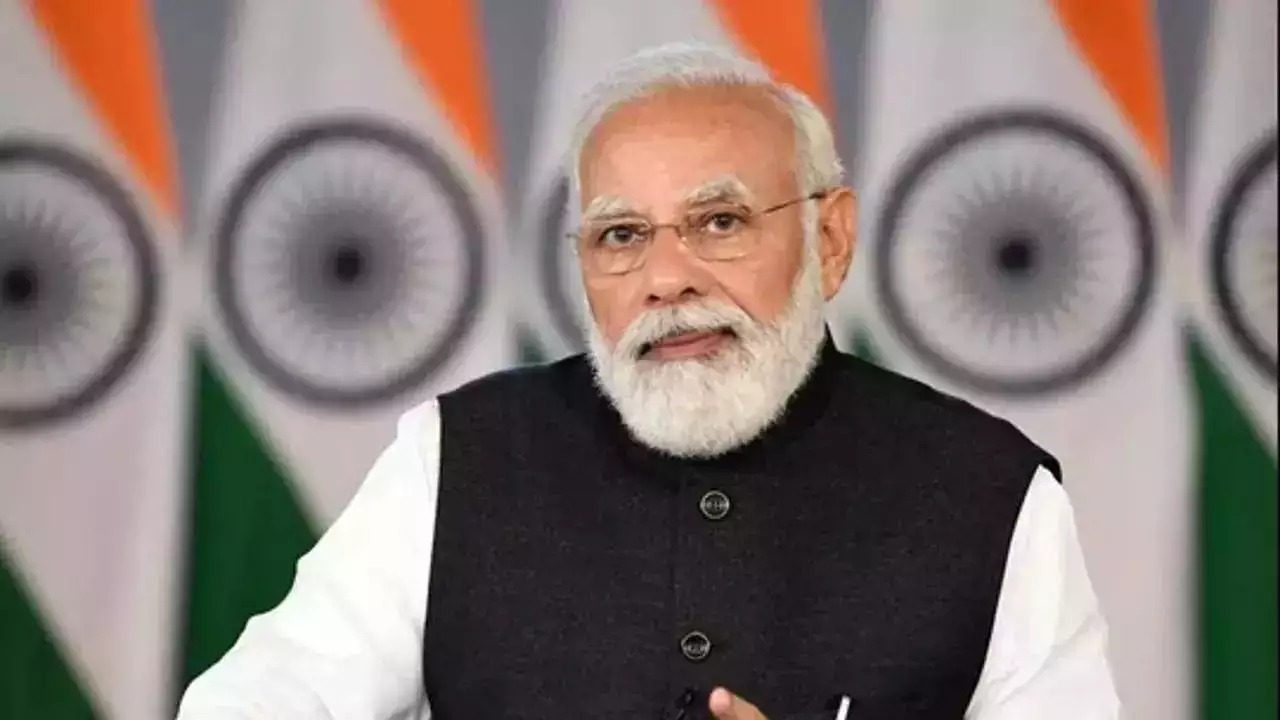
According to an article in the US-based strategic affairs journal The Diplomat, Chinese internet users respectfully refer to Prime Minister Narendra Modi as “Modi Laoxian,” which means “Modi the eternal,” notwithstanding the tense India-China border dispute.
The majority of Chinese believe that India, headed by Modi, can maintain a balance among major nations in the globe, according to Mu Chunshan, a journalist well-known for analyzing Chinese social media, particularly Sina Weibo (China’s version of Twitter). There are about 582 million active users on Sina Weibo.
On the Chinese internet, Prime Minister Narendra Modi goes by the strange moniker Modi Laoxian. Laoxian is a term used to describe an old immortal with peculiar talents. The moniker means that Chinese internet users believe Modi to be more extraordinary than previous leaders, he said.
They cite both his attire and outward look, which are seen as Laoxian-like, and parts of his policies, which are distinct from those of earlier India, Mu added.
On India’s relationships with other important nations, he stated that whether it is Russia, the United States, or countries in the Global South, India can have amicable relations with all of them, which is “quite admirable” to certain Chinese internet users.
As a result, Mu observed, “the name ‘Laoxian’ symbolizes the complicated emotion of Chinese people regarding Modi, mixing curiosity, bewilderment, and possibly a dash of skepticism.
“I have covered international news for over 20 years, and I have never seen Chinese internet users nicknaming a foreign leader. Modi’s moniker sticks out more than any other. He has undoubtedly had an impact on Chinese public opinion, he added.
Since taking office in 2014, Modi has hosted Chinese President Xi Jinping and former Premier Li Keqiang in addition to holding two extremely rare informal summits with the 69-year-old leader in Wuhan and later in Mamallapuram, a city close to Chennai. These meetings raised hopes for an improvement in relations between the two Asian superpowers.
After the Chinese military’s strong military activities in eastern Ladakh, which violated the agreements to settle the border issue and resulted in a nearly three-year-long military stalemate, Sino-Indian relations reached rock bottom.
High-level military commander negotiations between the two nations have taken place 17 times in an effort to end the deadlock.
India has insisted that peace in the border regions is a prerequisite for normalizing relations with China.
Due to his interactions with the Chinese people on Sina Weibo, which he launched in 2015 and has more than 2.44 lakh followers, Modi is also well-known in China.
To send a “strong message at the border, on the commercial front, and at a personal level too,” according to BJP General Secretary (Organization) B L Santhosh, the Indian government decided to prohibit 59 Chinese Apps in July 2020. He then left Weibo.
Chinese perceptions of India, according to Mu’s essay, are quite complex but often founded on a feeling of superiority and self-confidence.
Significantly, he claims that Chinese internet users think China’s efforts to use Pakistan as its “all-weather ally” are “unrealistic” because the distance between the two South Asian neighbors is “getting wider,” an apparent allusion to the current political and economic collapse Pakistan is going through. “The evidence over the last nine years has shown that there is greater opportunity for collaboration between China and India. For instance, China’s commerce with India is about USD 115 billion annually, which is far greater than the USD 30 billion in trade that China has with Pakistan, Mu said.
Of course, China is still thinking about Pakistan. Nonetheless, a lot of Chinese internet users have a realistic opinion of the two South Asian neighbors. The justification is stark: “The difference between Pakistan and India is growing, making the concept of using Pakistan to restrict India increasingly impractical,” he added.
He also discusses Chinese concerns about India’s rising standing among western nations, particularly the US, and New Delhi’s handling of the Ukrainian situation without jeopardizing its strong connections to both Russia and the US. “This is only one illustration of a widely held belief in China that China has become the target of the West while India is the preferred country of the West. How did India pull this off? Chinese internet users disputed the reason of India’s extensive network of friends abroad.
According to the report, the majority of Chinese people believe China and India can still work despite their feeling of superiority and self-confidence toward India. Of course, the majority of Chinese people don’t like it when India becomes too close to the United States.