




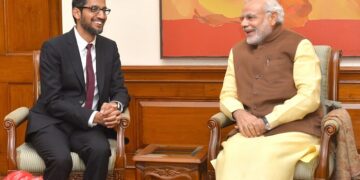



















Despite having every reason to highlight Adani Power, whose entrance into Bangladesh was facilitated by his patronage, during a celebration of a new stage in Delhi-Dhaka collaboration on energy, Prime Minister Narendra Modi chose to remain silent on the matter on Saturday.
On this occasion, a 131.57 km cross-border Indo-Bangla Friendship Pipeline that would allow Bangladesh to import high-speed diesel from the Numaligarh refinery in Assam was virtually inaugurated. In the presence of his colleague Sheikh Hasina, Modi discussed in-depth on the developments in their countries’ energy cooperation.
Modi had established the foundation for Adani Power’s entrance into Bangladesh eight years earlier as part of India’s commitment to enhancing the country’s neighbor’s electricity situation and starting a significant cross-border power trade.
After Modi’s visit to Bangladesh in June 2015, the foreign affairs ministry released a joint statement that read: “He (Modi) also underlined that India can be a key partner in accomplishing this aim and that many Indian corporations have the potential to engage with Bangladesh in this endeavour. He asked Bangladesh’s Prime Minister Hasina to make it easier for Indian businesses to enter the country’s electricity generating, transmission, and distribution industry.
In November 2017, the Bangladesh Power Development Board (BPDB) and Adani Power inked a 25-year power purchase agreement (PPA), two years after Modi’s visit.
As part of the agreement, an Indian business agreed to provide 1,496MW of energy generated by a coal-fired power plant in Godda, Jharkhand.
The fact that Adani Power (Jharkhand) started providing electricity to Bangladesh from the Godda plant earlier this month would have probably been anticipated of Modi, who is seen to be the architect of the cross-border power trade. He continued to remain silent, however, on the Adani group, which has been in the centre of controversy due to claims of stock manipulation and accounting fraud.
Modi is accused by the Opposition of giving the company special treatment due of his close relationship with Adani.
Our joint partnership has had great success in the energy sector. During the event on Saturday, Modi said that India now provides Bangladesh with more than 1,100MW of power.
The Maitree super thermal power plant, a joint venture between the BPDB and India’s NTPC, has already started up its first unit. Soon, the second unit will also be running.
According to Modi, the two nations’ oil commerce has reached $1 billion. The pipeline, which would allow Dhaka to import fuel at a lower cost and with less carbon emissions, was mentioned as a way that Bangladesh’s economy will be boosted by promoting the expansion of both agricultural and industry.
According to a source in Bangladesh, it would have been appropriate for the Indian Prime Minister to highlight the agreement between Adani Power and the BPDB in his speech under normal conditions “but we all know the problems surrounding the group in India,” the source added.
The controversy in Bangladesh around the sale may also be to blame for the absence.
The acquisition agreement with Adani Power has come under fire from sections of Bangladeshi civil society and the media for being “unfair” and motivated by profit.
Based on the 163-page PPA, various news stories in the Bangladeshi media over the last month or two have claimed that Dhaka would be paying exorbitant prices for power from the Godda plant.
With the BPDB requesting changes to the PPA, it became evident that Bangladeshi authorities had reservations about the price of energy from Adani Power (Jharkhand). As a result, officials of the company hurried to Dhaka at least twice to allay the worries.
“Last week, officials from Adani were also present here. They have promised that the price of energy from their facility would be comparable to, or even lower than, the price of electricity from other thermal power plants, according to a source in Bangladesh.
While the PPA was “iron clad,” according to several sources in the Bangladeshi government, negotiations with the Adani authorities had grown simpler as a result of the issues the group is having in India.
“The business will probably provide the BPDB with its first invoice in April. After all the hoopla, it will become obvious then that we have a good deal, the person stated.
Hasina said, “The pipeline will play a key role in ensuring the energy security of our people and accelerating the country’s growth.