






















It should come as no surprise that the New York Times, Washington Post, and other left-leaning Western media outlets frequently dispatch some of their most heinous and horrible “reporters” to cover Southeast Asia, especially India, in an attempt to malign the nation and take advantage of the existing fault lines, sow discord, and do other things to help exert pressure on the current administration and further their own agendas.
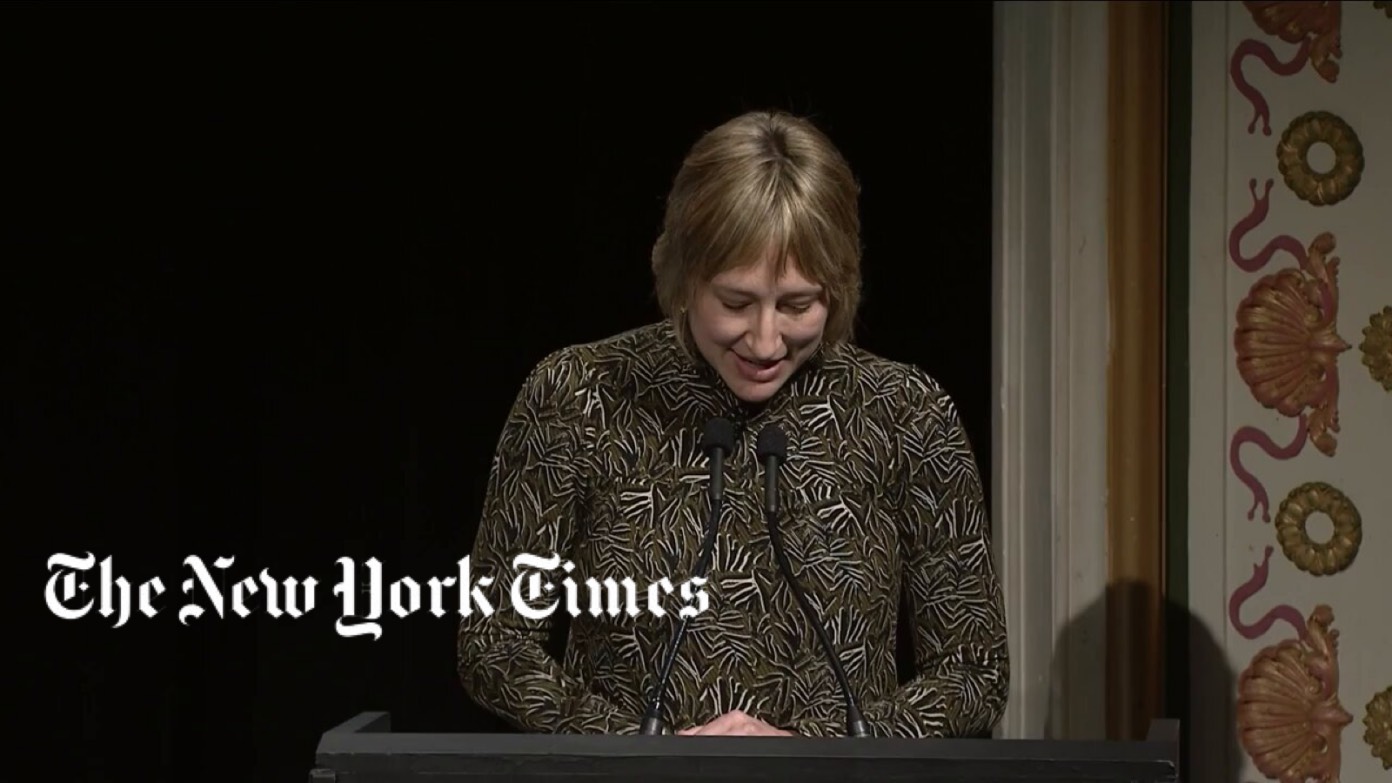
One such person was Emily Schmall, a Chicago-based reporter for The New York Times, who made her bias against the Modi government and disdain for nationalist media clear at the 2024 Camden Conference when she discussed her time spent in India while working as a New York Times South Asia correspondent in Delhi.
Schmall’s talk at the Conference is a masterclass in how Western journalists let their biases take control of their common sense and spin a tale with an agenda so disconnected from reality that, when their assumptions come apart, they go on to place the blame on everyone but themselves.
Deconstructing Emily’s speech is crucial because it was heavily infused with woke propaganda, now characteristic of New York Times writers.
Emily launches her speech with a biting swipe at Republic TV, one of India’s most popular English news outlets. She compares it to Fox News in the United States and labels it as the official spokesperson for the Modi administration.
Additionally, there are hundreds of TV news networks, many of which are strongly politicised and powerful. Shouting bouts are cheap to produce and look good, like here. Schmall argues that Republic TV, which is similar to Fox News in India, is no longer unique because it is blatantly pro-government.
Selective quotations from facts on NDTV, Republic TV, and in the media:
Naturally, she conveniently fails to mention the many occasions in which Republic TV has adopted a stance that differs from that of the central government. One such instance is the Sabarimala case, in which Arnab Goswami’s channel fiercely opposed those who sought to allow women of menstrual age entry into the sacred temple’s sanctum sanctorum.
Schmall then turns his attention to NDTV, praising it as the “last bastion of independent TV news” that the energy magnate Gautam Adani had purchased. He connects Adani and PM Modi and suggests that the PMO may have been involved in the news channel’s acquisition.
Once more, she conceals from her the closeness of NDTV journalists to ministers during the UPA-I and UPA-II administrations; in fact, some of them were so close to the leaders that they were captured on tape arranging cabinet positions.
Many of the network’s longstanding executives and anchors have left since Adani won NDTV in a hostile takeover effort in 2022. However, more and more of the biggest stories, the most daring probes, and the greatest watchdog reporting are turning up on the digital pages of tenacious online news startups rather than in print media like newspapers or television. According to the author, grants, reader subscriptions, and donations fund a large portion of this job, and the government and its allies specifically target the journalists who perform this work.
She describes Gautam Adani as a villain who took over NDTV, but she purposefully omits to discuss the allegations of tax evasion against the channel as well as the anomalies in its funding. The New York Times journalist, who is notorious for her biassed and one-sided reporting, fails to inform her audience about the accusations of tax fraud and money laundering against former NDTV promoters Prannoy Roy and Radhika Roy, as well as their leadership roles during Adani’s takeover of the company.
The “scrappy online startups” she is referring to are probably far-left propaganda sites like “The Wire,” which had to endure the humiliation of removing multiple articles about “Tek Fog” and “Meta Stories” after it was discovered that they were nothing more than amateurish hit pieces against the national government.
Schmall then turns to a tactic ideal for propagandists posing as journalists: highlighting points with chosen data sets and half-truths. It’s WhatsApp’s turn to be disparaged and vilified next. Cleverly, the New York Times writer uses one event from the anti-Hindu Delhi riots to suggest that a Hindu mob savagely lynched a Muslim man. As usual, she gives no background on the events leading up to the riots or the wider plot gradually coming to light in the legal system.
Schmall brings up a random incident from the 2020 Delhi riots
It’s important to note that Emily says nothing about the death threats that former BJP spokesperson Nupur Sharma received for merely standing up for her God’s dignity in a Times Now discussion. A portion of the video was posted online to incite hatred and hostility among the Muslim community. Raising ‘Sar Tan Se Juda’ slogans in protest of Sharma for allegedly blaspheming against Prophet Muhammad, thousands of people flocked to the streets. Enraged mobs around the nation descended on Sharma’s effigies and demanded her blood, hanging, burning, and beating them with slippers.
At least six Hindus died as a result of showing support for Nupur Sharma. The most famous of these was Kanhaiya Lal, a Udaipur-based Hindu tailor, whom two Islamists fatally slashed in broad daylight because he backed the former BJP politician. Despite the fact that the incident caused national outcry, Emily says nothing about it in her address.
She asserts that the Modi administration has weaponized WhatsApp to spread false information and incite “nationalistic fervour” among the populace. Once more, she provides no proof to support her assertions and fails to acknowledge that WhatsApp, like X and Facebook, is a social media platform that is openly accessible and that all political parties are free to use it to mobilise their resources and disseminate their message to their constituents.
Modi has established a reputation as a leader who keeps his word and follows through on commitments. As a result, according to polls that consistently show this, the public has a growing sense of trust in Prime Minister Modi, making him one of the most well-liked and endorsed PMs in the country’s history.
Emily bemoans the fact that the BJP is utilising all of its resources to capitalise on the increasingly positive perception of Prime Minister Modi, his affinity for the common Indian, and his unique ability to captivate audiences with speeches in order to establish the party’s supremacy and use it as a tool for gaining political and electoral advantages.
Emily Schmall states, “Ram Mandir was built on the rubble of the 450-year-old Babri mosque.”
Emily claims that the 1992 act of terrorism by Hindu karsevaks led to the construction of the Ram Mandir. She claims that the 450-year-old mosque that Hindu nationalists destroyed in December 1992 served as the foundation for Ram Mandir, but she skips over mentioning the archaeological evidence and the testimonies of renowned historians like KK Mohammed and Meenakshi Jain that suggested there may have once been a temple beneath the Babri structure.
An inscription in Vishnu Hari that dates back to the temple’s building was discovered among the wreckage during the Babri complex’s demolition. This discovery provides irrefutable proof against Islamist assertions that there was no Hindu edifice beneath the complex. Emily, predictably, ignores these subtleties and goes on to her list of propaganda items.
Schmall recalls the casualties sustained by the Indian side as well as the violent battles that broke out between Chinese and Indian troops in the Galwan Valley. She doesn’t bother to tell her listeners about the number of losses recorded on the Chinese side or how the Indian troops humiliated their Chinese counterparts. Additionally, she attempted to place all the blame for the border dispute between the two countries on the shoulders of the Modi administration, despite the fact that it was clear from sources close to the border that the Chinese were the aggressors and had been for some time.
Schmall makes a mocking reference in one of her speeches to the information minister—likely Anurag Thakur—calling her over for tea and reading the headlines from The New York Times. Given that The New York Times has a problematic past of producing news pieces that are anti-Indian and Hinduphobic, it’s hard to find anything wrong with the minister. You can read a story from 2021 here that reiterates the anti-Hindu and anti-Indian prejudice of the New York Times.
Those who succeeded in cancelling Vivek Agnihotri’s news conference on “The Kashmir Files” included Emily Schmall
Even if she went on and on about other topics, such as the application of the UAPA to people who are charged with major crimes, an informed listener would have by now concluded that she was just venting and that her remarks were the product of a disgruntled journalist who had failed to complete her “assignment.” It’s important to note that, despite Schmall’s pontifications on the necessity of room for dissent, she was involved in the cancellation of Vivek Agnihotri’s news conference at the Foreign Correspondents Club in New Delhi in May of 2022. The filmmaker of “The Kashmir Files” was supposed to speak at a news conference about his movie and the truth about the Hindu genocide in Kashmir.
Journalist Pankaj Yadav, a former member of the Foreign Correspondents’ Club of South Asia, had disclosed that President Munish Gupta had cancelled Vivek Agnihotri’s press conference scheduled for May 5 at the Club owing to threats made by office bearers Emily Schmall, Sebastian Farcis, Tawqeer Hussian, and Kumkum Chadha to resign from the Governing Committee if it was permitted.