


























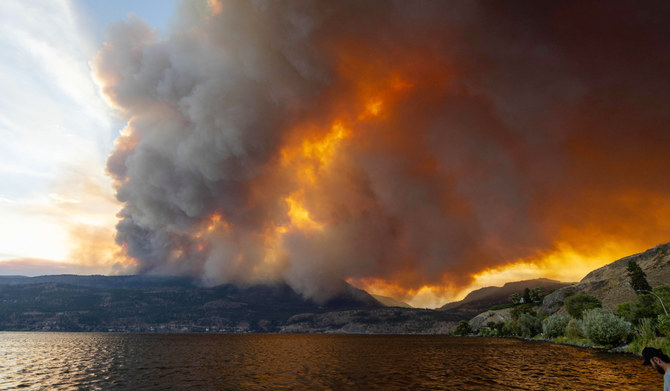
As “severe and fast changing” wildfires threatened vast portions of the picturesque Okanagan Valley, including the city of Kelowna, authorities in western Canada’s British Columbia pleaded with tens of thousands of people to heed warnings and leave on Saturday. Bowinn Ma, the province’s minister of emergency management, described the situation at the well-known boating and trekking resort as “highly dynamic.”
A total of 36,000 individuals were on notice to be prepared to escape, and 30,000 people were under evacuation orders, according to her. At a press conference that followed in the afternoon, Ma said, “We cannot emphasize strongly enough how important it is to follow evacuation orders when they are issued.” Not just for the residents of such homes, but also for the first responders who often return to attempt to persuade individuals to leave, they are a matter of life and death.
The 150,000-person city of Kelowna was engulfed in heavy smoke as it became the latest population center to be affected by the spectacular wildfires that have charred millions of acres of land throughout Canada this summer. According to Prime Minister Justin Trudeau, he talked with Premier David Eby of British Columbia about the “rapidly evolving and incredibly devastating wildfire situation” and promised government assistance in fighting the blazes.
The isolated city of Yellowknife, population 20,000, was evacuated due to fires far away in the nearby Northwest Territories, leaving the area mainly deserted. Wildfires have been pushed closer to Yellowknife by winds, but Saturday offered some reprieve as overnight rain caused temperatures to drop significantly.
Shane Thompson, the environment minister for the Northwest Territories, said on Saturday on X, a site previously known as Twitter, that since the evacuation order was issued on Wednesday, the majority of people have gone by vehicle while many have taken emergency planes. There are still around 1,000 vital employees in the city and its environs, he said.
While water bombers have been seen flying low over the city and the Canadian military is also assisting, those personnel remained to install fire defenses.
THE ‘INCREDIBLE’ EXODUS
On one of the first aircraft out, Tony Whitford, a former commissioner for the Northwest Territories and longstanding resident of Yellowknife, landed in Calgary. He awarded the evacuation high honors. Whitford, 82 and confined to a wheelchair, congratulated the organizers and added, “My compliments to them all.” things’s remarkable how complicated 20,000 people make things. It went without a hitch.
A number of towns and Indigenous groups have already been evacuated. Because of the flight from Yellowknife, the region’s near-Arctic population has decreased by 50%. The continuous fires have resulted in “terrible loss,” Trudeau said reporters after visiting Yellowknife evacuees on Friday as they landed in Edmonton, Alberta, unsure of when they may be able to return home.
28-year resident of Yellowknife Martha Kanatsiak landed in Calgary late on Friday. “I’m OK, yet I’m unhappy, melancholy, and anxious. I’ve never seen anything like this, the retired Inuit man, 59, told AFP. According to municipal authorities, 40 planes from Yellowknife carrying around 3,500 people have landed in Calgary. The city has also made close to 500 hotel rooms accessible.
NORTHWEST UNITED STATES THREAT
In West Kelowna, British Columbia, which is divided from its bigger, namesake neighbor by Okanagan Lake, fires have already burned a number of homes. According to local media, one of them is the Lake Okanagan Resort, which is well-known for having entertained prominent leaders including British prime minister Margaret Thatcher.
Eby issued a stop-work order on non-essential trips to the region on Saturday. The order, which prohibits guests from staying in hotels and other short-term lodgings, applies to Osoyoos, which is close to the US border, as well as Kelowna and the surrounding communities of Kamloops, Oliver, Penticton, and Vernon.
“If you are currently staying in accommodations in these areas, we are asking you to voluntarily check out early and free up those spaces for evacuees and responders,” Ma said.
Several thousand people were compelled to evacuate wildfires in Washington State while over the border in the United States, where at least one fatality was confirmed, according to local media. A portion of the crucial I-90 highway was shut down, and officials ordered an evacuation for Medical Lake, a community outside of Spokane that is adjacent to a US Air Force installation.
Approximately the size of Greece and nearly twice as large as the previous record of 7.3 million hectares, Canada is now witnessing a record-breaking wildfire season with official estimates of over 14 million hectares (34.6 million acres) already burnt. So far, four individuals have died. Scientists claim that because of global warming caused by humans, natural disasters are becoming more deadly and common.