


























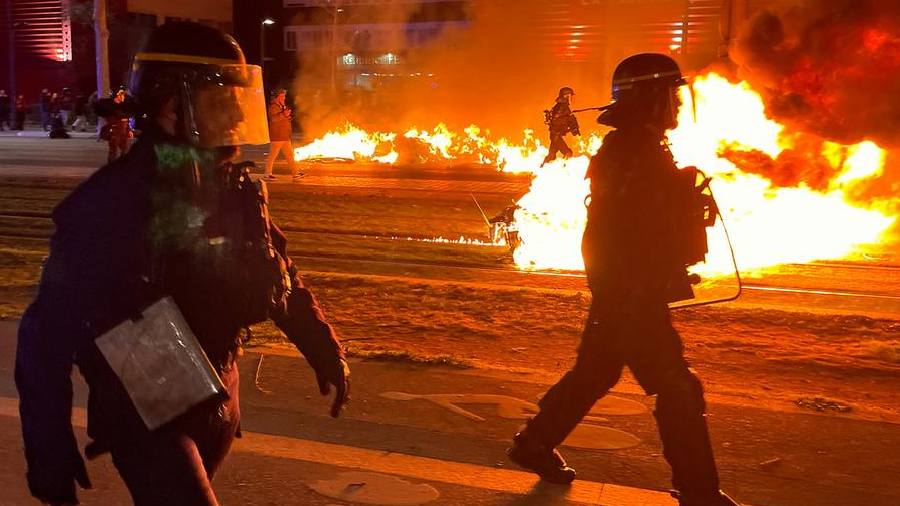
On Saturday, there was conflict between protestors and police officers in downtown Paris for the third consecutive night over the government’s decision to postpone a parliamentary vote on controversial pension changes.
According to President Emmanuel Macron, raising the retirement age by two years to 64 is necessary to prevent the system from collapsing.
Rival opposition groups submitted two different resolutions of no confidence, which will be discussed on Monday afternoon, after ministers approved the proposal by decree on Thursday, skipping the lower chamber of parliament. They’re predicted to fall short.
What took place last Saturday?
According to police, over 4,000 people gathered at Place d’Italie after being prohibited from holding a protest near the National Assembly building because of violent altercations the night before.
A restriction was imposed due to “high risks of public order disruptions.”
According to the Le Monde newspaper, a group of demonstrators set rubbish on fire, vandalised bus shelters and billboards, and threw barriers used to block roadways towards police.
According to the newspaper, 73 people were detained, and riot police used tear gas and water cannons to disperse the crowd, just like they had on previous nights.
Several students and activists marched through the Forum des Halles retail centre in Paris earlier on Saturday while shouting loudly and emitting red smoke.
Another night of violence was also recorded in Lyon, a city in the southeast, when many encounters between small groups of people and the police resulted in a use of tear gas by the latter.
On Friday, a group of protesters attempted to break into a town hall and set the structure on fire, leading to the arrest of more than 30 individuals.
Several French towns, such as Marseille, Montpellier, and Nantes, also saw marches, mostly calm ones. In Nantes, one banner said “Death to the king,” perhaps in reference to Macron.
What will the protest movement do next?
The majority of France’s major unions have joined forces and pledged to keep organising their members in an effort to reverse the pension reforms.
Several unions instructed employees to continue their rolling strikes, significantly impacting high-speed and regional train services this weekend, among other services.
About 10,000 tonnes of garbage were left festering on the streets of Paris by Friday as a result of continued efforts by the city’s municipal trash collectors.
According to union organisers, Monday’s walkouts will cause roughly a third of flights at several French airports to be cancelled.
The CGT union claimed that on Friday night, its members had shut down the TotalEnergies oil refinery in Normandy. A refinery in southern France was earlier in the day blocked off in a like manner.
The eighth day of countrywide industrial action since mid-January is also planned for Thursday.
Public antagonism is insufficient to thwart plans
According to surveys, two-thirds of the French people opposed the pension reform, which was already facing strong opposition.
Nevertheless, the abrupt action to avoid a parliamentary vote, using the contentious article 49.3 of the constitution, sparked uproar among the people as well as within the political establishment.
Next week, opposition legislators will attempt to get enough support in parliament to pass a no-confidence motion that would overthrow the government and abolish the legislation.
Yet it’s generally assumed that Prime Minister Elisabeth Borne’s government would remain in place.
A scenario considered to be very unlikely would need support from around half of the right-wing Republicans opposing the move. They would also require the combined backing of the formidable extreme left and extreme right groups in the National Assembly.
The pension changes were at the forefront of Macron’s reelection campaign the previous year.
Although his administration maintained that France needs to increase the retirement age to match that of its European neighbours, opponents claim that the reforms are unjust to those who start working at a young age in physically demanding occupations and to women who take time off from their employment to have children.
The turmoil is reminiscent of the Yellow Vest rallies that broke out in late 2018 in response to skyrocketing gas costs and caused Macron to partially reverse his stance on a carbon tax.
In addition, Macron had intended to implement pension changes during his first term in office, but he had to abandon the plan after running for president last year on a promise to do so.