























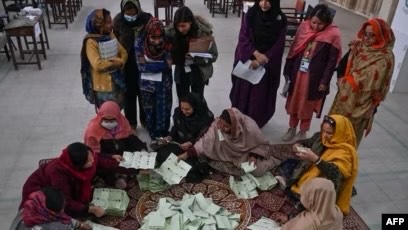
Pakistan held its much-awaited elections on Thursday, but the results were overshadowed by intermittent violence and the total shutdown of internet and mobile phone services, casting doubt on the validity of an already contentious vote.
After nine hours of voting, polling places throughout the South Asian country ended at 5 p.m. local time, and the event was mainly calm.
Just prior to the polls for about 128 million eligible voters, the Interior Ministry made an early-morning notification stating that the phone service outage was necessary to “maintain law and order” and “mitigate potential security threats.”
The ministry neglected to address the internet outage that occurred the day after three different bombings outside campaign headquarters in the southwest province of Baluchistan killed thirty people. The bombs were attributed to the militant group Islamic State. Election Day saw a number of fatal militant attacks across the nation, most of which claimed the lives of police officers.
Whoever wins the election, according to analysts, will represent a populace that is profoundly dissatisfied with the political system, has little faith in the democratic process, and is very concerned about the country’s ability to continue economically.
The last elected prime minister, Imran Khan, is imprisoned, and the Muslim League (Nawaz) Party, led by three-time former prime minister Nawaz Sharif, is thought to be the preferred choice of the strong military. A crackdown on his Pakistan Tehreek-e-Insaf Party, or PTI, supported by the military has left many dissatisfied with this democratic exercise.
First-time voter Faiza Tariq, a woman, expressed her optimism that her vote would benefit both her and her country, Lahore in the east.
Among those who abstained from voting was Fazal-Ur-Rehman, who claimed to have little faith in the system.
“Whether or not I vote is irrelevant. “Those who are meant to hold power will do so,” he declared.
Pakistani expatriate Nazward Atta claimed she came back to vote solely to protest the perceived injustice.
She stated, “We simply want to alter Pakistan’s destiny and future.”
Anam Khan and other voters expressed disapproval at the interruption of communication services.
“Why? Is this place experiencing a war? Is their goal to prevent users from sharing videos on social media platforms? God willing, people can accomplish that eventually,” she remarked.
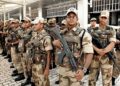
With an estimated population of 241 million, Pakistan is the fifth most populated country in the world. The Pakistani government provided security for tens of thousands of voting places throughout the country by deploying over 650,000 army, paramilitary, and police troops.
The interior ministry announced that mobile services were being partially restored nationally and will shortly be fully restored, several hours after the polls closed.
Widespread claims that Pakistan’s military-backed interim government was trying to rig the elections in order to keep candidates loyal to Imran Khan’s party from winning the majority were triggered by the suspension of phone and internet services.
Khan is a key character.
In the run-up to the election, Khan, the 71-year-old well-liked leader, was found guilty of highly contested corruption and other offences and given significant prison sentences.
A months-long statewide crackdown on the PTI led by the cricket hero-turned-political leader saw hundreds of members and candidates imprisoned without being charged and only released when they left the party or withdrew from the race.
Shortly after the services were cut off, PTI stated on X, “Pakistanis, the illegitimate, fascist regime has blocked cell phone services across Pakistan on polling day.”
Director of the Wilson Center’s South Asia Institute, Michael Kugelman, remarked, “Khan remains a central figure in the election despite being in jail.” “He still has a sizable fan base that will support the independent candidates his party is supporting.
But it seems that by stopping cell services, the state is fostering an atmosphere that is favourable to rigging. Kugelman told VOA that “this casts doubt on the government’s insistence that this election will be free and fair and threatens to deny many Pakistanis the right to vote for who they choose.”
Critics point to an internet outage
The internet blackout on election day was criticised by Amnesty International as “reckless” and a “blunt attack” on the rights to peaceful assembly and freedom of expression.
The candidate running for prime minister, Bilawal Bhutto Zardari, denounced the communication services’ suspension.
“All mobile phone services throughout the nation must be restored right away. Zardari tweeted on X, referring to the Election Commission of Pakistan, “I have asked my party to approach both the ECP and the courts for this purpose.”
Approximately 190 million people in Pakistan use cell phones, of which 128 million make use of mobile broadband services. Many voters were unable to access the electoral commission’s data system to obtain information about voting places and other matters due to the service interruption.
Pakistan’s top election commissioner, Sikandar Sultan, stated that the only agency with the authority to decide whether to halt phone service are the security forces tasked with upholding peace and order.
When asked if the panel would order the reinstatement of service, Sultan told reporters in Islamabad, “I don’t think the commission should interfere in their work, nor will it do so.”
Mainstream Pakistani television journalists claimed that because of the ban, they were unable to swiftly report instances of rigging and other anomalies from the pitch throughout the day.
There are no two ways about it: the purpose of this law was to rig the election and limit media coverage. That’s what it is,” Dawn News channel prime-time political discussion show host Arifa Noor said in a live broadcast.
Observers pointed out that Pakistan had previously conducted elections in the face of increased security risks and terrorist threats but had maintained communication.
The lower house of parliament in Islamabad’s National Assembly is run by independent candidate Mustafa Nawaz Khokhar. “Election day rigging begins when mobile networks are shut down on polling day,” Khokhar stated.
“It is wrong to cut off candidates from their workers and agents on election day. How is one meant to monitor and call attention to any anomalies? The election would have been rigged by the time the news surfaced, according to Khokhar.
Sharif assured
Sharif asserted that a coalition administration would not be able to handle Pakistan’s economic issues, giving the impression that his party would triumph and establish a government on its own.
After casting his ballot in his home city of Lahore, he warned reporters, “For God’s sake, don’t mention a coalition government.”
Over five thousand candidates were running for 266 general seats in the National Assembly, which has 342 members. In all, 12,600 people are vying for four province assembly seats in Pakistan.
In a survey conducted on election eve, the American polling firm Gallup discovered that almost two thirds of Pakistanis “lack confidence in the honesty of their elections.”