

















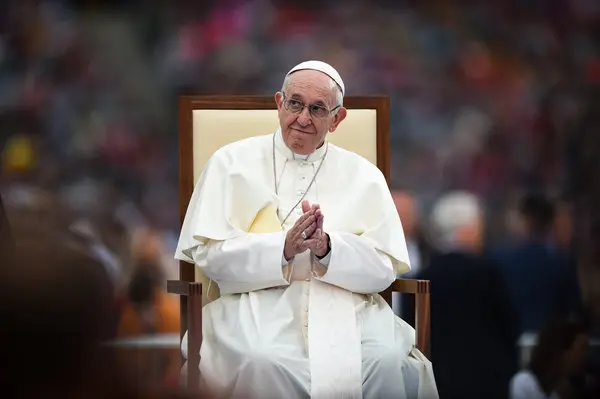
At a sizable assembly of Catholic bishops and laypeople on Saturday, Pope Francis said that it was “urgent” to ensure that women be fully included in positions of church administration and that studies on the possibility of women serving as deacons be published within a year.
However, despite Francis’ continuous outreach to the homosexual community and openness to consider blessing same-sex couples, the summit did not take a firm stand on that topic and backed off from calling for the welcome of LGBTQ+ Catholics.
Following a month of discussions behind closed doors, Francis’ conference on the future of the Catholic Church came to a conclusion late Saturday with the adoption of a 42-page document covering a wide range of topics that will now be discussed at a second session the following year. Francis is just being provided the options to think about; none of them are legally enforceable. The required two-thirds majority was needed for each paragraph to succeed, but the ones that addressed women and questioned the need of clerical celibacy received the greatest number of “no” votes.
As part of his broader reform initiatives to make the church a more inviting environment where laypeople have more influence in the life of the church, Francis summoned the synod more than two years ago. Both expectations and concerns about significant change were raised by the process and the two years of grassroots Catholic canvassing that came before it.
In a hierarchy where women are prohibited from ordination, progressives had hoped the event would send a message that the church would be more accepting of LGBTQ+ individuals and give them greater leadership positions. Conservatives stressed the importance of adhering to the church’s 2,000-year history and cautioned against starting a discussion on such topics because it may open a “Pandora’s Box” and cause split.
Francis implemented his idea that the “People of God” seated in the pews are more significant than the preachers by allowing women and laypeople to vote alongside bishops, a first for the church. In particular, his demand for “co-responsibility” motivated women who wanted to revive the ministry of female deacons, which was present in the early church. The group ultimately offered some of the strongest recommendations for women, but none of them were final.
“It is imperative to ensure that women can engage in decision-making processes and take on roles of responsibility in pastoral and ministry,” the final language said. It said that Francis has greatly raised the proportion of women in senior roles inside the Vatican and that local churches need to follow suit. The subsequent proposal garnered the highest number of “no” votes (279–67).
The delegates demanded that the findings of the two study groups that Francis had commissioned be made public before to the opening of the synod’s second session in October 2024, and they also asked for theological and pastoral research on the issue of women serving as deacons to continue. The Women’s Ordination Conference, an advocacy group for female priests, issued a divided verdict.
“In certain ways, the text appears to acknowledge the harm that women have endured at the hands of the church, but it doesn’t go far enough in addressing the resolution of those wounds, choosing instead to defer those concerns to further research and commissions,” the organization stated in a statement.
Even though the working draft that went into it had explicitly included the appeals for a broader welcome for “LGBTQ+ Catholics” and those who have long felt excluded by the church, there was not a single reference of homosexuality in the text. People who feel excluded by the church due to their marital status, identity, or sexual orientation simply asked to be listened to, accompanied, and have their dignity upheld, according to the final statement.
The delegates also agreed that there are still issues inside the church regarding gender identity and sexual orientation, referring to them as “problems” similar to the ethical discussions surrounding artificial intelligence and end-of-life care in general society.
The Rev. James Martin, a Jesuit who leads an outreach program for LGBTQ+ Catholics and was appointed by Francis as a delegate to the synod, said that although the lack of even a passing reference to homosexuality was regrettable, it was not unexpected given the intensity of the opposition during the discussion. Martin sent an email saying, “LGBTQ people are part of the church and they deserve to be seen, valued, and, above all, loved, whether or not you want to use the term.”
The delegates also discussed other matters, including as the subject of clerical sexual abuse and the damage caused to laypeople, nuns, and children by abuses of bishops’ unbridled power. The delegates reached the consensus that “decisive and appropriate intervention” is necessary in situations of adult abuse.
Furthermore, it said that considering the obvious conflict of interest, more thought must be given to whether bishops should even be conducting investigations and passing judgment on accused priests. The statement said, “Many bishops find it challenging to balance their roles as father and judge in the delicate matter of handling abuse cases,” and it raised the prospect of changing canon law to delegate the task to a third party.
Some have questioned the validity of the conference itself since laypeople were allowed to participate as voting members. They pointed out that the “Synod of Bishops” was established to provide the pope the perspective of bishops, who are the apostles’ heirs, not laypeople.
Cardinal Gerhard Mueller, who was nominated by Francis to the synod but made no secret of his disapproval of it, said that the assembly scarcely qualified as a synod of bishops. He gave a harsh assessment of the conference in an interview that was published on Saturday with National Catholic Register. He said that it was a staged, theologically light assembly that seemed to be the work of the Holy Spirit but was really intended to undermine church doctrine.
The participation of laypeople as really embodying the spirit of a synod was welcomed by the Rev. Timothy Radcliffe, a British Dominican invited by Francis to provide spiritual reflections at various points throughout the gathering. Even yet, Radcliffe stressed that extreme change was never being considered during the conference. He explained to reporters that the synod was not about making decisions but rather discovering new ways to be the church. And for that reason there will be hiccups. Errors are certain to happen. And because we are on our way, that’s okay.