






















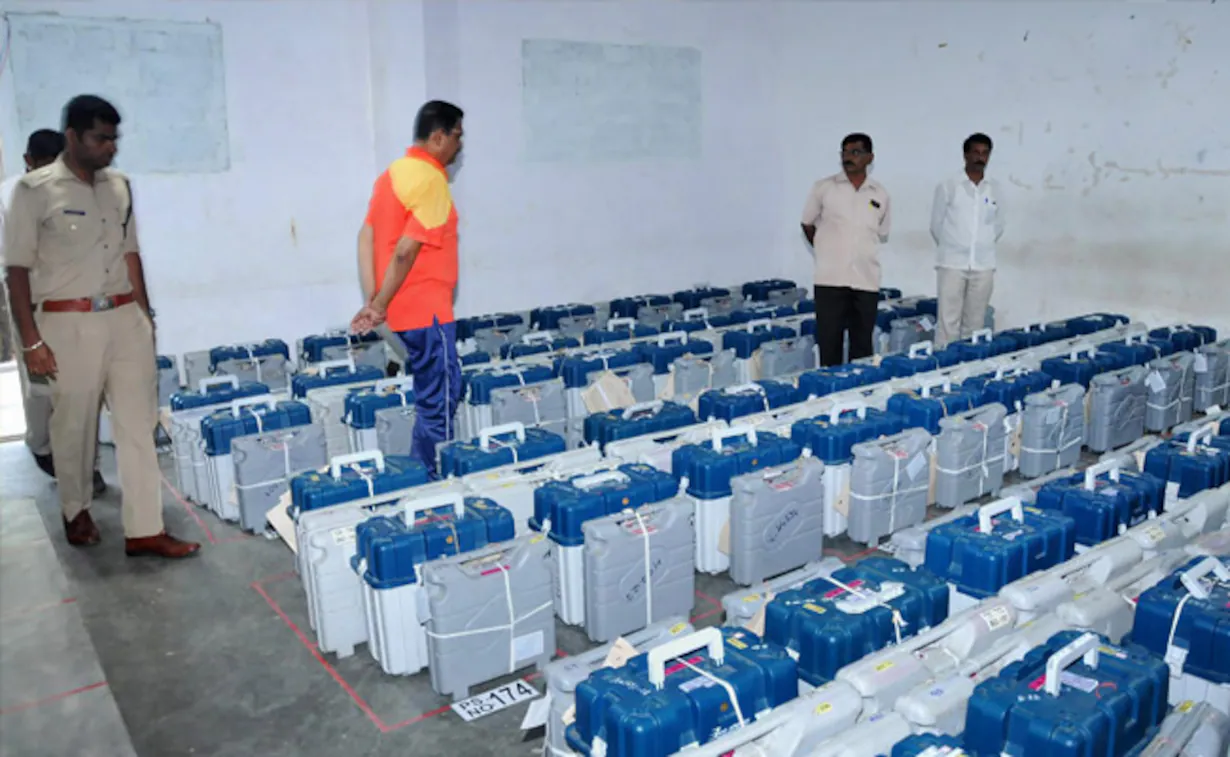
Karnataka has started counting the votes cast in the May 10 Assembly elections, which saw a tough contest between the BJP and the Congress.
36 centers around the state started counting the votes at 8 am, and election authorities anticipate that a clear picture of the result would likely become obvious by noon.
In order to prevent any unforeseen occurrences, extensive security precautions have been established across the State, particularly in and near the counting centers, according to official sources.
For the election of delegates to the 224-member Assembly on May 10, the State saw a “record” turnout of 73.19 percent.
The election fates of prominent figures, including JD(S)’s HD Kumaraswamy, Chief Minister Basavaraj Bommai of the BJP, Siddaramaiah and DK Shivakumar of the Congress, and many more, will be revealed today.
The results of the exit surveys.
The leaders of the Congress and BJP are “jittery” about the results, with the majority of exit polls indicating a close race between the two parties. The JD(S) appears to be anticipating a hung vote, which would allow them to participate in government formation.
The majority of pollsters have placed the Congress in the lead over the BJP, who are currently in power, but also predicting a hung Assembly in the state.
this time’s positions of the various political parties
The Congress is hoping for a morale-boosting victory to give it the much-needed breathing room and momentum to position itself as the main opposition player in the 2024 Lok Sabha elections, while the ruling BJP, having bet on the Modi juggernaut, is looking to break a 38-year-old poll jinx where the people have never voted the incumbent party to power.
It is also unknown if the JD(S), headed by former Prime Minister H D Deve Gowda, would act as a “kingmaker” or a “king” by controlling the formation of a government in the case of a hung verdict, as it has in the past.
Karnataka had a three-cornered election, with the aforementioned parties engaging in direct conflict in the majority of the seats, as has been the norm for the last 20 or so years.
AAP, the ruling party in Delhi and Punjab, has also announced its slate of candidates. Additionally, there were a few seats where minor parties were competing.
The leaders of all political parties made a strong case for “a government with full majority” throughout the raucous, no holds barred campaigning that concluded on Monday. They emphasized the need for a clear mandate to build a strong and stable administration, as opposed to what transpired after the 2018 elections.
After obtaining 104 seats, the BJP became the single-largest party, followed by the Congress with 80 seats and the JD(S) with 37. While the BSP and Karnataka Pragnyavantha Janatha Party (KPJP) each elected one lawmaker, there was also one independent member.
In the 2018 elections, the BJP came in second with 36.22 percent of the vote, followed by the JD(S) with 18.36 percent.
The BJP, which was the single biggest party, claimed a claim and established the government since no party had a clear majority at the time and Congress and JD(S) were attempting to create an alliance. However, it was abandoned three days before a vote on a trust because the leader of the saffron party was unable to get the necessary support.
The Congress-JD(S) combination then established the government with Kumaraswamy as the chief minister, but the shaky regime disintegrated after 14 months as a result of the resignation of 17 lawmakers from the governing coalition and their subsequent defection to the BJP. This made the BJP’s comeback to power possible. In the ensuing byelections conducted in 2019, the governing party took home 12 of the 15 seats.
The governing BJP currently has 116 MLAs in the outgoing Assembly, followed by the Congress with 69, JD(S) with 29, BSP with 1, independents with 2, the speaker with 1, and six vacancies (due to deaths and resignations to join other parties before the elections).