

























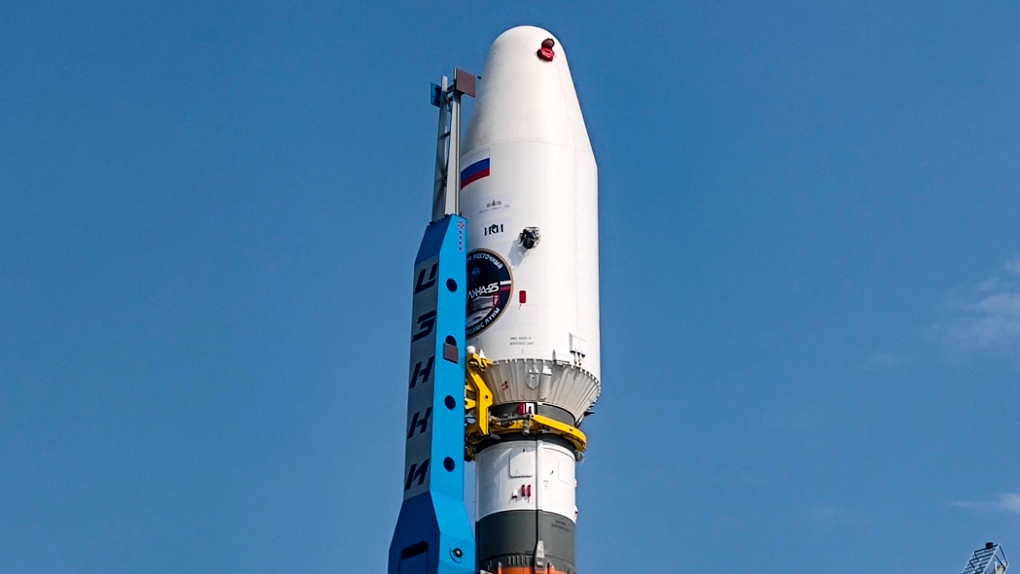
Friday saw the launch of a rocket carrying a lunar landing vehicle on Russia’s first moon mission in over 50 years, competing with an Indian spacecraft for first place.
The Luna-25 spacecraft is being launched by Russia for the first time since 1976, when it was a part of the Soviet Union, from the Vostochny spaceport in the Far East.
On Aug. 23, the Russian spacecraft is anticipated to arrive on the moon, on the same day as an Indian spacecraft that was launched on July 14. The journey to the moon’s vicinity will take the Russian spacecraft around 5.5 days. After arriving, it will circle the moon for three to seven days at a distance of roughly 100 kilometers (62 miles).
The Soviet Union, the United States, and China are the only three nations that have accomplished successful moon landings. Russia and India are competing to make the first landing to the south pole of the moon.
The Russian space agency, Roscosmos, said that it seeks to “ensure Russia’s guaranteed access to the moon’s surface” and demonstrate that Russia “is a state capable of delivering a payload to the moon.”
Popular Russian space expert Vitaly Egorov declared, “Study of the moon is not the goal.” The purpose is political rivalry between the USA and China, two superpowers, as well as a number of smaller nations that are vying for the title of space superpower.
Russia’s space program is hampered by sanctions put in place after it invaded Ukraine and made it more difficult for it to use Western technology. Analysts claim that the tiny lunar rover that the Luna-25 was originally intended to carry was dropped in favor of a lighter, more reliable craft.
Egorov said that although home electronics were heavier, foreign electronics were lighter. Roscosmos’ principal mission is simply to land on the moon in order to reclaim lost Soviet know-how and learn how to do it in the modern day. Scientists may have the duty of investigating lunar water.
According to camera feed from Roscosmos, the Luna-25 launched perfectly from the Vostochny Cosmodrome in Russia’s Far East.
Russian President Vladimir Putin’s favorite project, the spaceport is essential to his attempts to transform Russia into a space powerhouse and relocate Russian rockets from the Baikonur Cosmodrome in Kazakhstan.
Indian spacecraft smashed into the moon’s surface during an earlier attempt to land near the moon’s south pole in 2019.
Scientists are particularly interested in the lunar south pole because they think water may be present in the continuously shadowed polar craters. Future explorers may be able to create oxygen and rocket fuel from the frozen water in the rocks.
According to Ed Bloomer, an astronomer at the Royal Observatory in Greenwich, Britain, “the moon is largely unaltered and the entire history of the moon is written on its face.” It is immaculate and unlike anything on Earth. It functions as its own lab.
The Luna-25 will collect lunar rock and dust samples. Before constructing any facility on the moon, it is essential to understand its climate, according to Bloomer. If not, “we could be building things and having to shut them down six months later because everything has essentially been sandblasted.”