




















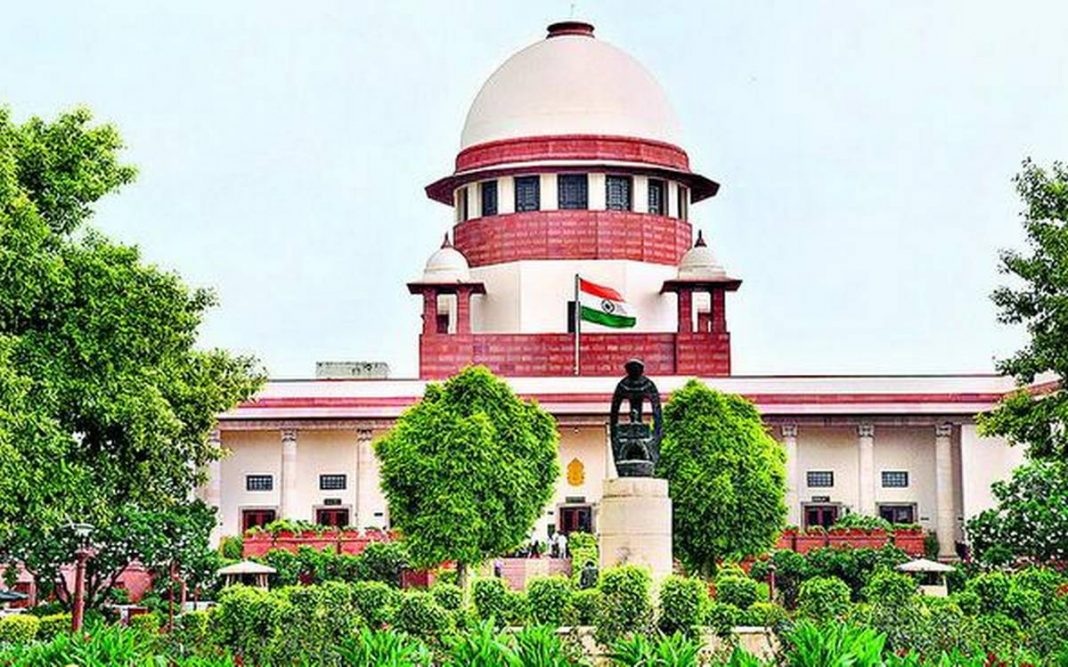
On Thursday, the Supreme Court raised concerns about a number of constitutional rulings that had been issued and permitted Jammu and Kashmir to apply some articles of the Indian Constitution after 1957.
The Supreme Court was referring to the Constitution (Application to Jammu and Kashmir) Amendment Orders, which have been in effect since 1957 and as of August 6, 2019, respectively.
A five-judge panel led by Chief Justice D Y Chandrachud expressed astonishment at senior attorney Dushyant Dave’s assertion that Article 370, which granted the former state of Jammu and Kashmir special status, had served its function and reached the end of its existence.
Dave made the case that Article 370 has served its purpose since the time of the Constituent Assembly of Jammu and Kashmir ended in 1957, in contrast to other top attorneys like Kapil Sibal and Gopal Subramanium.
I humbly suggest that Article 370 has served its purpose. Its goal has been accomplished. In the event that the Constitution is changed tomorrow and a new provision is added that we would want to apply to Jammu and Kashmir as well, provision 370 (1) would still be in effect.This Article 370 (1) may be required in this specific situation, according to Dave, who was speaking on behalf of the petitioner Rifat Ara Butt. After the constituent assembly for the state of Jammu and Kashmir had finished its job, CJI Chandrachud questioned Dave: “If Article 370 has worked itself out and achieved its purpose, then where was the occasion thereafter to issue constitutional orders post 1957?”
Dave informed the court, which was made up of Justices Sanjay Kishan Kaul, Sanjiv Khanna, B R Gavai, and Surya Kant, that once Jammu and Kashmir’s constituent assembly voted to remain part of India, the decision was final.
It cannot be done again. As far as Article 370(3) is concerned, the President becomes functus officio in 1954 (after the issuing of the constitution order implementing the majority of the Indian constitution’s provisions). Your lordship explicitly consents to this role, he said. Dave responded, saying that only Article 370(1) exists in order to periodically prolong any modifications made to the Indian Constitution during the seventh day of hearing on a batch of complaints contesting the Centre’s decision from August 5, 2019.
CJI Chandrachud responded to Dave’s question by citing many exclusions in Article 370: “So, your whole argument is that Article 370 has now worked itself out, after the constituent assembly has finished its mission. But it would contradict constitutional practice, at the very least. Because constitutional orders that gradually modified the articles of the Constitution in reference to the state of J-K were issued even after 1957. Which basically suggests that Article 370 was still in effect after that.
Therefore, he said, it would not be accurate to say that Article 370 had fulfilled its purpose and that the interim clause had really taken on the status of permanence in the Indian constitutional framework. The CJI explained to the senior counsel that there would be no need for us to make any constitutional orders going forward starting in 1958.
The CJI added, “Then where is the power to alter the Constitution at all,” following his first query to Dave. If your claim is valid, no provision of the Constitution relating to the state of J-K may be changed after the constituent assembly made its decision in 1957. This goes against everything that has been argued.
Dave argued that because the constituent assembly of Jammu and Kashmir had already decided to become a part of India, clause 3 of Article 370 only applied to the continuance of the whole scope of that article. The bench said that Dave’s arguments merit attention.
“We must address the submission. I’m attempting to research it. Accepting that submission would have one internal contradiction, as clause 2 of Article 370 would prohibit any amendments to the constitution after the constituent assembly finished its work in 1957. This is contradicted not only by constitutional practice but also by the acceptance of the state of J-K and the Government of India that amendments were being made to the constitution. On August 22, the hearing would get back up.
The court asked the petitioners’ attorneys to wrap up their arguments on August 22 so that it could then hear the Center’s submissions. The top court had questioned on Wednesday whether the Jammu and Kashmir Reorganisation Act, which split the former state into two union territories, could have been passed by Parliament under President’s Rule in 2018–2019.
With Jammu and Kashmir’s accession to India in October 1947, the top court declared on August 10 that the former princely state’s sovereignty had been “absolutely complete” and that it was “really difficult” to say that Article 370 of the Constitution, which granted it special status, was of a lasting nature. A Constitution court received many petitions in 2019 that contested the repeal of Article 370’s provisions and the Jammu and Kashmir Reorganisation Act, which divided the former state into Jammu and Kashmir and Ladakh, two union territories.