

























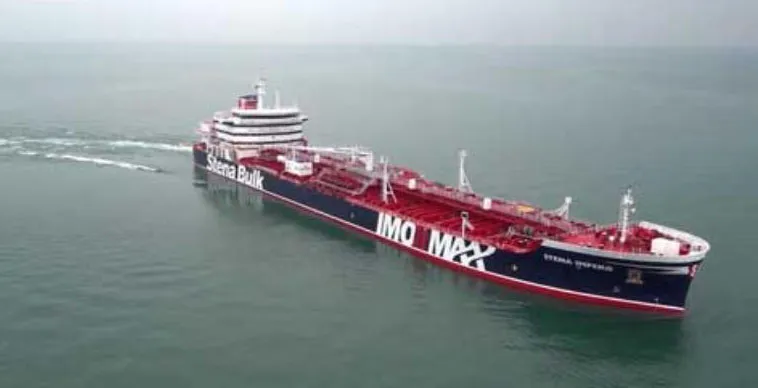
Tracking information revealed that an American-owned oil tanker that has long been suspected of transporting Iranian crude oil that has been subject to sanctions started unloading its cargo late on Saturday, despite Tehran’s threats to attack ships in the Persian Gulf because of it.
Even as Tehran and Washington work toward a deal of billions of dollars in frozen Iranian assets in South Korea for the release of five Iranian-Americans detained in Tehran, the fate of the cargo onboard the Suez Rajan has been entangled in the broader tensions between the US and the Islamic Republic.
The paramilitary Revolutionary Guard of Iran has already issued a warning, saying that anybody engaged in unloading the shipment “should expect to be struck back.” The US Navy has progressively escalated its presence in the Middle East in recent weeks, sending the troop- and aircraft-carrying USS Bataan there and contemplating sending armed men aboard commercial ships passing through the Strait of Hormuz to prevent Iran from capturing more vessels.
The Suez Rajan, a tanker under the flag of the Marshall Islands, was transferring its oil to another tanker, the Mr. Euphrates, close to Galveston, Texas, some 70 kilometers (45 miles) southeast of Houston, according to ship-tracking data obtained by The Associated Press. That will probably make it possible to discharge the cargo.
Requests for response from US representatives and Oaktree Capital Management, the Los Angeles-based private equity business that owns the Suez Rajan, were not immediately fulfilled.
The story of the Suez Rajan started in February 2022 when the organization United Against Nuclear Iran said that it believed the ship was carrying oil from Iran’s primary oil distribution facility in the Persian Gulf, Khargh Island.
It sat in the South China Sea off the northeastern coast of Singapore for many months before abruptly and mysteriously heading towards the Gulf of Mexico. Analysts think the Suez Rajan’s cargo was probably confiscated by American authorities, but as of early Sunday, no court records regarding the Suez Rajan were available for public viewing.
While this is going on, Iran has captured two ships close to the Strait of Hormuz, one of which was carrying supplies for the US oil company Chevron Corp. State media linked the current seizures to the fate of the cargo when the chief commander of the Revolutionary Guard’s marine branch promised harsher action against anybody discharging the Suez Rajan in July.
Rear Admiral Alireza Tangsiri declared at the time, “We hereby declare that we would hold any oil company that sought to unload our crude from the vessel responsible and we also hold America responsible.” “The hit-and-run era is over, and if they hit, they should anticipate getting hit back.”
In response to a request for comment about the unloading of the Suez Rajan, the Iranian embassy to the UN did not provide a response right away. Recently, Western-supported naval groups operating in the Persian Gulf warned of a higher chance of Iranian ships being taken over near the Strait of Hormuz.
With the signing of the nuclear agreement in 2015, Iran was once again able to sell oil freely on the global market. But in 2018, the country’s restrictions were reinstated when then-President Donald Trump unilaterally withdrew from the agreement. That effectively shut off a large portion of Iran’s lucrative crude oil trade, which was a key driver of both its economy and its government. Additionally, it started a cat-and-mouse search for Iranian oil shipments and a series of increasing strikes since 2019 that have been blamed on Iran.
The Suez Rajan languished for months in the Gulf of Mexico, presumably as a result of businesses being concerned about the danger from Iran, and the delay in unloading her cargo had become a political problem for the Biden administration.
A coalition of Democratic and Republican US senators wrote to the White House on Wednesday, requesting an update on what was happening with the ship’s cargo, which was estimated to be worth $56 million. The US Victims of State Sponsored Terrorism Fund, which pays people harmed by the September 11 attacks, the 1979 Iran Hostage Crisis, and other terrorist assaults, may use the money, according to those who indicated it might be used for that purpose.
The letter said, “We owe it to these American families to implement our sanctions.
The Quds Force is the expeditionary division of the Revolutionary Guard that conducts operations across the Middle East, according to the US Treasury.
United Against Nuclear Iran’s chief of staff, Claire Jungman, applauded the transfer’s eventual completion.
According to Jungman, “we strike a blow against terrorism that targets not only American citizens but also our global allies and partners” by denying the (Guard) of essential resources.