




















The G20 India Summit, which took place in Delhi, demonstrated both the scientific and economic might of India, according to Union Minister of State (Independent Charge) for Science and Technology Jitendra Singh.
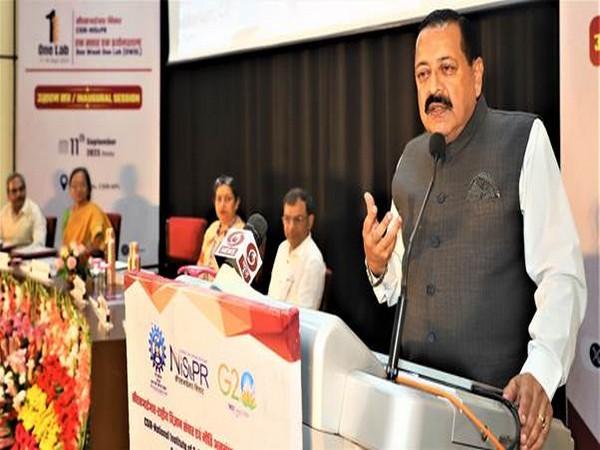
On Monday, MoS Singh spoke at the OWOL program’s opening ceremony at the CSIR-National Institute of Science Communication and Policy Research (CSIR-NIScPR), New Delhi.
The government has institutionalized the marriage of ancient wisdom with cutting-edge contemporary technology under Prime Minister Narendra Modi. Previously known as the TKDL (Tradition Under Primal Knowledge Digital Library), we had the traditional knowledge library. Even the Bharat Mandapam or some of the most recent monuments built by this administration exhibit the finest synthesis of cutting-edge scientific knowledge, technology, and design with the traditional legacy that we have accumulated through the decades, he added.
“I am pleased that India has taken the lead in accomplishing this under PM Modi. With the Anusandhan National Research Foundation, which will get up to 70% of its financing from non-governmental sources, we are also transitioning from the kind of work method we have used in the past, said MoS Singh.
After the ‘One Week One Lab’ (OWOL) initiative was a success, Jitendra Singh advocated the observance of ‘One Month One Theme’ in order to coordinate the work of the numerous CSIR labs.
“While each (CSIR lab) has a unique USP, many of them have a similar concept… The Aditya Mission, he added, is an example of the “Whole of Science” strategy, where all Departments pooled resources, including ISRO, DST, CSIR’s National Aerospace Laboratories, Tata Institute, etc. As a result, subsequently, in the next stage, we may have a greater integration based on themes.
According to MoS Singh, the philosophy underpinning OWOL is integration—both within the scientific community and into society at large. OWOL enables research institutions to engage with the public and demonstrate to them that the work they are doing is really for the benefit of society.
Jitendra Singh said that the NIScPR could serve as a torchbearer and that the CSIR laboratories could each share ten success stories.
“The goal is to get in touch with the possible recipients. No matter how important and beneficial an experiment may be, he remarked, “if it doesn’t reach the people for whom it is intended, it fails to genuinely serve its purpose.
In order to achieve the Sustainable Development Goals (SDG) of the United Nations, the New Delhi Declaration, which was approved at the G20 Summit, committed itself to executing India’s program known as the “Lifestyle for Environment Mission” (LiFE) and developing artificial intelligence.
The G-20 has reiterated its commitment to sustainable and green development by signing the “Green Development Pact.”
The G20 Summit welcomed the launch of the Global Initiative on Digital Health (GIDH) inside a WHO-managed framework and endorsed India’s initiative to create and maintain a Global Digital Public Infrastructure Repository (GDPIR).
The founding of the Global Biofuel Alliance (GBA) by the leaders of Singapore, Bangladesh, Italy, the United States, Brazil, Argentina, Mauritius, and the United Arab Emirates on PM Modi’s suggestion at the G20 Summit was a historic accomplishment. GBA intends to act as a catalytic platform, encouraging international cooperation for the development and wide-scale use of biofuels.
Jitendra Singh launched the NIScPR publications and journals during the event, as well as the Science Media Communication Cell.
N. Kalaiselvi, Secretary, DSIR and DG, CSIR, Venu Gopal Achanta, Director, CSIR-NPL, and Ranjana Aggarwal, Director, CSIR-NIScPR were among the dignitaries who spoke to the audience.