


























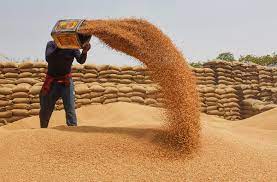
To increase domestic availability and stabilize increasing prices of these two important essentials, the government on Wednesday announced the sale of an extra 50 lakh tonnes of wheat and 25 lakh tonnes of rice from the Central Pool on the open market.
Due to a lack of demand for the commodity under the Open Market Sale Scheme (OMSS), the government has decreased the reserve price of rice by Rs 2 per kg to Rs 29 per kg.
Regarding a potential reduction in wheat import duties, the administration said that since the situation is fluid and changing, it would act accordingly in the future.
Since June 28, the OMSS has allowed the government-owned Food Corporation of India (FCI) to sell wheat and rice in bulk to purchasers including flour millers and small dealers via an online auction.
According to Sanjeev Chopra, the food secretary, prices of two commodities have been in the news for the last several months due to an upward tendency that has been seen.
Wheat offtake under the OMSS has been successful so far. However, throughout the last two to three auctions, the weighted average price of wheat has been rising. He said that there hasn’t been considerable offtake of rice.
According to Chopra, the administration believed that boosting the rice reserve price may provide better outcomes.
“The government has decided to offload 50 lakh tonnes of wheat and 25 lakh tonnes of rice in the open market through the OMSS,” the man added.
This is in addition to the sales of 5 lakh tonnes of rice and 15 lakh tonnes of wheat that were announced on June 28 under the OMSS.
Aside from that, the secretary said that the government has lowered the reserve price of rice by Rs 2 per kg, from Rs 31 per kg to Rs 29 per kg.
However, because to the positive reaction from the traders under the OMSS, the reserve price of wheat has remained the same.
According to him, the OMSS has so far seen the auctioning of around 7-8 lakh tonnes of wheat while selling very little rice.
According to Chopra, the government is hopeful that these steps would not only increase market availability but also aid to lower costs and reduce food inflation.
“…We will keep adjusting them based on the feedback in the next weeks. The main goal is to control food inflation, he said, adding that the government has enough stock on hand to conduct more vigorous auctions if necessary.
The secretary said on the probable drop in wheat import duties, “Right now, we have taken these measures. These change and are dynamic. We shall behave in accordance with future regulations.
In order to guarantee that wheat stock limitations are not broken, he said that the Centre is vigorously pursuing states.
Ashok K. Meena, Chairman and Managing Director of FCI, said that the OMSS operation began early this year on June 28 in response to the rising trend in wheat and rice prices.
Seven online auctions have been held thus far, including this one. In the current e-auction, the amount of wheat that was initially offered for sale—4 lakh tonnes—has been lowered to one lakh tonnes. According to him, almost 8 lakh tonnes of wheat have been sold so far.
The weighted average selling price of wheat on June 28 was originally Rs 2,136.36 per quintal, but that price has now increased to Rs 2,254.71 per quintal at today’s e-auction, according to the FCI CMD.
This demonstrates that the market’s demand for wheat is rising, he said.
Since July 5, around six rice e-auctions have been held, but the offtake has not been as expected, possibly as a result of the high reserve price, which is now set at Rs 31.73 per kg, the expert stated.
About 1,500 tonnes of rice were sold via the OMSS in today’s e-auction, he added.
Food grain supplies at FCI are sufficient. In addition to the buffer requirements, it has an extra 217 lakh tonnes of rice and 87 lakh tonnes of wheat available.