








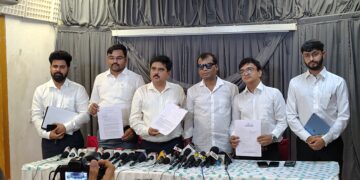

















As a form of protest against the Centre’s decision to levy a 40% tariff on the export of the household staple, traders here said on Monday that they have chosen to shut down onion auctions indefinitely in all Agriculture Produce Market Committees (APMCs) in Maharashtra’s Nashik district.
According to reports, the majority of the APMCs in the area, including Lasalgaon, the biggest wholesale onion market in India, kept their onion auctions closed on Monday due to the decision.
According to traders, the federal government’s plan to levy a 40% tariff on onion exports up to December 31, 2023, would negatively impact onion producers and the export of onions.
According to Nashik District Onion Traders Association president Khandu Deore, the association met on Sunday and decided to permanently shut off onion auctions in this area.
“In the event that onions are delivered to an APMC, the auction for those onions will be held after which the process will be permanently halted since it will take time for the decision to reach farmers. According to the requests made by several farmer organizations, this was also agreed at the conference,” he added.
According to reports, onions were delivered to several locations, and an auction for them started at the APMCs.
The president of the onion-potato market at the Vashi APMC in neighboring Navi Mumbai, Sanjay Pingle, requested the Center to reconsider its decision to impose a 40% levy on the export of onions.
Speaking to PTI, Pingle said that the state’s onion producers would suffer as a result of the government’s decision.
“Farmers have been putting a lot of pressure on us to close the market and cease selling onions. We have been instructed not to sell the onions by at least 10–15 organizations. Today is the last day of the onion auction in the whole Nashik district. Local markets will shut over the next several days as well. He said that the APMC has also made the decision to assist the farmers.
The prices of the onion, which we were exporting for Rs 25 (per kg), would decrease to Rs 15 if we pay the government a 40% tariff. If things continue as they are, we would have no choice but to buy onions for Rs 10, which won’t even cover a farmer’s production costs, Pingle said.
He said that a certain agency had submitted a “wrong report” to the federal government about the matter, failing to account for the rising cost of labor, fertilizer, and other factors related to the production of onions.
He said, “Even today, there is a balance of 80% onion stock in Maharashtra and 70% in Madhya Pradesh,” and he added that this is because of low rainfall, which has led to strong onion output in Maharashtra and Karnataka.
If the price of an onion was Rs. 10 (per kg) ten years ago, and it is now Rs. 17–18 (after accounting for manufacturing costs), there has not been much of a rise. According to him, it costs roughly Rs 25–30 in the wholesale market and Rs 35–40 in the retail sector.
Pingle encouraged the government to distribute onions via the PDS, much like it does with rice and wheat.
“Sell it through PDS at Rs 2 to Rs 10 (per kg) if you want the poor people to be able to purchase onion at a lower cost,” he said.
Additionally, he said that the Centre’s decision would result in a sharp decline in onion exports, which would increase revenue for growers in Pakistan, Iran, and Egypt.
Pingle advised Nitin Gadkari, a minister for the Union, to raise this matter with the Centre.
He said that a decision would be made in the next days as “we want to be with the farmers” on this matter.
He suggested that the Centre make the choice after calling a meeting of the interested parties.