




















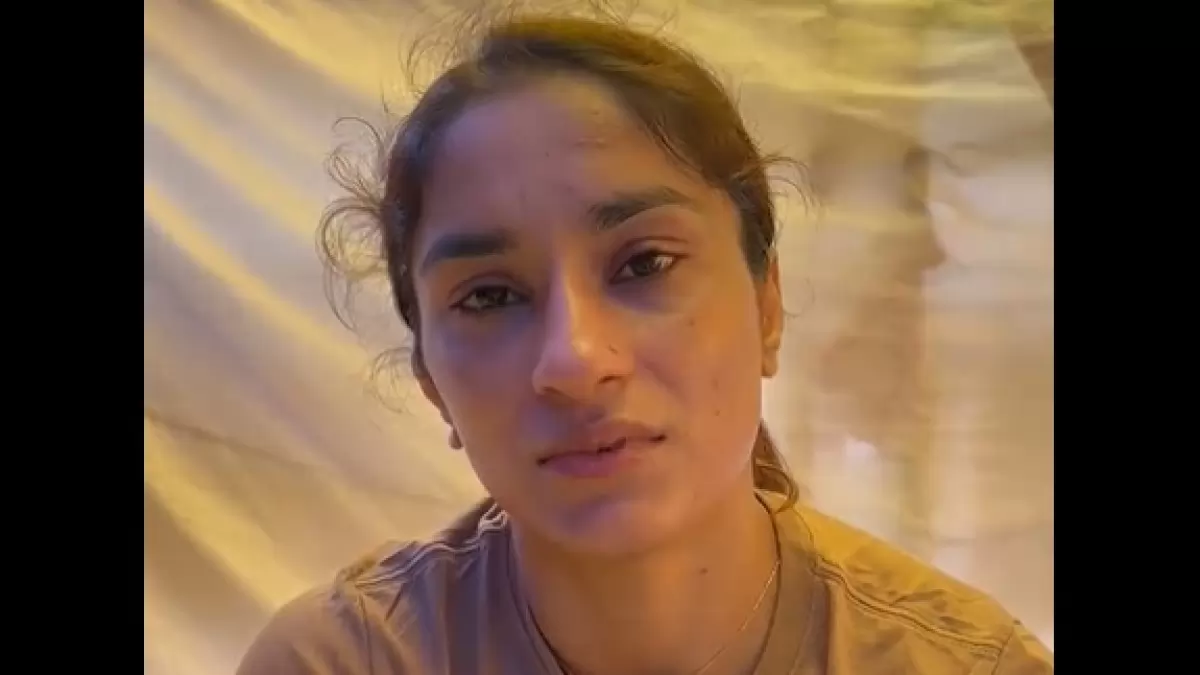
Vinesh Phogat, a professional wrestler who has led the large-scale protest by wrestlers at Delhi’s Jantar Mantar, said democracy was “being murdered openly at Jantar Mantar” on Monday when the prime minister unveiled the new Parliament building.
At a time when people are dying in the nation and several women wrestlers have been sitting out competitions for more than a month in protest of sexual harassment, the gold medalist from the Commonwealth and Asian Games accused the Centre of a “false pretence” in a video message posted on Twitter.
She said that the Mahila Samaj and Kisan leaders who had travelled across borders to participate in the “Mahila Mahapanchayat” march to the new Parliament building had been arrested by the police.
“On the one hand, the Prime Minister opened a new democracy building. On the other side, our folks are now being arrested,” her tweet’s Hindi translation said.
Protest wrestlers established a “Mahila Mahapanchayat” next to the new structure after a month-long demonstration in Jantar Mantar, around two kilometres from Parliament, and said they would go through with their plan no matter what. No protester will be permitted to approach the new Parliamentary building, according to the police, since authorization to host the “Mahila Mahapanchayat” has not been obtained.
The protesting wrestlers, headed by Olympic medalists Sakshi Malik, Vinesh Phogat, and Bajrang Punia, as well as Commonwealth and Asian Games champion Bajrang Punia, have called for the arrest of Brij Bhushan Singh, the president of the Wrestling Federation of India, whom they claim sexually abused many female athletes.
In order to preserve peace and order, security has been increased by increasing police deployment, erecting several barriers and police pickets, and intensifying patrols across the national capital and its surrounding regions.
In order to show their support for the protesting wrestlers, hundreds of farmers from Uttar Pradesh would assemble at the Ghazipur border of Delhi on Sunday morning, according to farmer activist Rakesh Tikait. From other border crossings, farmers were expected to go to Delhi.