



















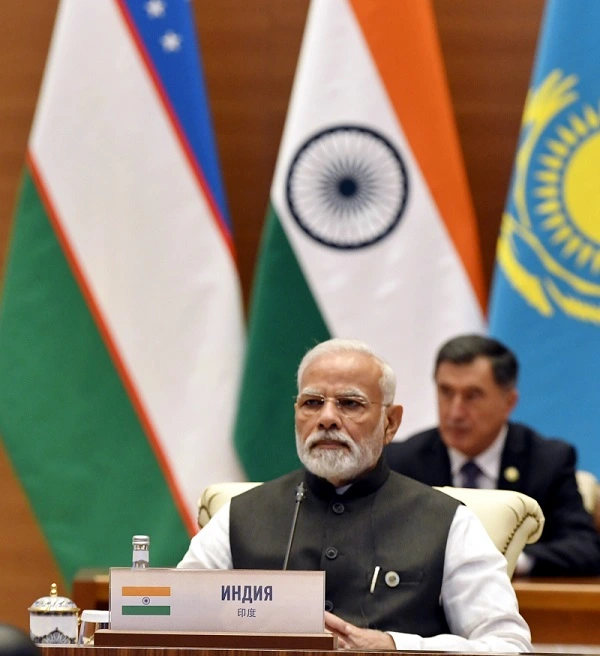
Today’s Shanghai Cooperation Organisation (SCO) conference will be held mostly in India. Xi Jinping, the president of China, and Shehbaz Sharif, the prime minister of Pakistan, will also attend the summit.
Prime Minister Narendra Modi will serve as the meeting’s chairperson. The three main topics that are anticipated to be on the agenda are prosperity, regional security, and terrorism. The term “SECURE,” which was created by Prime Minister Modi during the 2018 SCO Qingdao Summit, served as the inspiration for India’s SCO chairship theme.
Its initials stand for S—security—, E—economic development—, C—connectivity—, U—unity—, R—respect for territorial integrity and sovereignty—, and E—environmental protection.
Vladimir Putin, the president of Russia, will attend the conference this week as well. This occurs after a conflict between Russia and Ukraine was declared to be concluded. India has denounced the conflict but has not opposed Russia in any vote.
“This is not the era of war,” Prime Minister Modi said in a side conversation with President Putin at the SCO summit in Uzbekistan last year. This phrase was included in the G20 communiqué, which India presided over at the time.
On June 30, Prime Minister Modi and Russian President Vladimir Putin spoke on the phone and discussed bilateral cooperation, the Shanghai Cooperation Organisation (SCO), and the G20.
The Summit is open to all SCO members, including China, Russia, Kazakhstan, Kyrgyzstan, Pakistan, Tajikistan, and Uzbekistan.
Iran, Belarus, and Mongolia have all been invited to participate as observer states. Turkmenistan has also been invited as the Chair’s guest, as is customary for the SCO. There will also be representatives from the Secretariat and SCO RATS, two of the SCO’s bodies.
Pakistan and China have indicated their desire to attend the summit, which is one of its main centrepieces. Pakistan is expected to attend the conference despite being ostracised internationally for harbouring terrorists.
There has been a continuing standoff and significant force buildup at Indian positions on the LAC in eastern Ladakh since Chinese attack at Galwan in 2020. The Indian side has also sent out a large number of soldiers and built up their infrastructure quickly.
According to the Wall Street Journal (WSJ), PM Modi said that “peace and tranquilly in the border areas is essential” for “normal bilateral ties” with China before to his travel to the US.
“We firmly believe in upholding the rule of law, preserving national and territorial integrity, and finding peaceful solutions to conflicts. India is also totally dedicated to defending its sovereignty and dignity, according to PM Modi in an interview with a US journal.
According to a statement from the Chinese Foreign Ministry’s spokeswoman, Mao Ning, Jinping, who will attend the SCO’s virtual summit being hosted by India, would make significant statements at the gathering and plot the organization’s future expansion with other leaders.
Shehbaz Sharif will take part in the SCO gathering as well. According to the Pakistani Ministry of Foreign Affairs, Indian Prime Minister Narendra Modi issued the invitation to Pakistani Prime Minister Shehbaz Sharif.
The two leaders’ attendance coincides with China’s opposition to a United Nations resolution that would have designated Lashkar-e-Taiba terrorist Sajid Mir as a global terrorist, a move that was also sharply criticised by New Delhi. Mir is wanted for his alleged involvement in the 26/11 terrorist attacks in Mumbai.
India became an observer member of the SCO in 2005, and during the Astana Summit in 2017, it was granted full membership, marking a turning point in its ties with the Organisation.
India has participated actively and constructively in all SCO activities during the last six years.
India replaced Uzbekistan as the SCO’s chairperson for the first time during the Samarkand SCO Summit in September 2022.
The breadth and intensity of the SCO’s exchanges and interactions across a broad range of industries have hit new highs under India’s chairmanship.
In the SCO, startups and innovation, traditional medicine, digital inclusion, youth empowerment, and shared Buddhist heritage, India established five new pillars and priority areas for cooperation.
India spearheaded the creation of two new SCO mechanisms: the Experts Working Group on Traditional Medicine and the Special Working Group on Startups and Innovation.