
























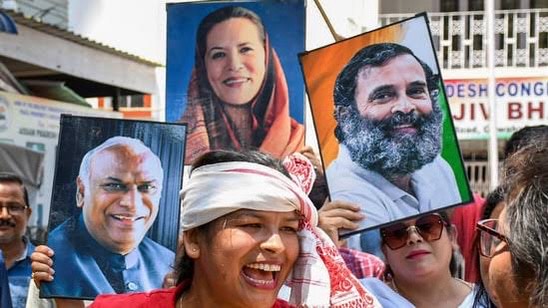
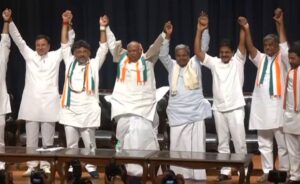
Today the results of the Karnataka Assembly elections were announced, and the Congress party came out on top, far above the required 113 votes. There are numerous ways in which Congress established its government in the southern states that might be interpreted as alleviating the anti-Hindu elements. The party pledged to outlaw Bajrang Dal and grant Muslim reservations in its manifesto. Despite this, the party has a history of dropping charges against members of the terrorist organisation Popular Front of India (PFI), which is outlawed and collaborating with its political affiliate, the Social Democratic Party of India.
The Congress party made clear in its pre-election manifesto for the Karnataka Assembly Elections that it intended to outlaw groups like PFI and Bajrang Dal. The party’s pledge to take a strong and uncompromising stance against those who are said to incite animosity among communities based on caste and religion was emphasised in the manifesto. It compared Bajrang Dal to PFI, even though it is one of the few organisations that is actively working to address atrocities committed against Hindus during riots or elsewhere. The PFI’s participation in actions deemed anti-Indian by the Congress party was highlighted in a comparison between the Bajrang Dal and the PFI. But it’s crucial to remember that the Bajrang Dal hasn’t been connected to any anti-national or security-threatening activity. The organisation’s main priorities include protecting Hindus and fighting for their rights. It can be argued that the Congress party’s pledge to outlaw the Bajrang Dal in the city where Bajrang Bali was born demonstrates its purported anti-Hindu stance.
The state’s Islamists will intensify their anti-Hindu operations if Bajrang Dal is outlawed. With limits placed on Bajrang Dal, Hindus risk losing a significant voice in addressing concerns like land jihad, love jihad, and other challenges that target the Hindu population. Away from power, the BJP may also choose to focus on constitutional discussions and legal manoeuvres rather than calling for specific acts to counter these Islamists’ methodical expansionist endeavours.
Since religious conversions have been forced in Karnataka since the time of Tipu Sultan, whose birth anniversary was commemorated by the state during the Congress administration, the active existence of the Bajrang Dal is therefore necessary. If Bajrang Dal is outlawed in Karnataka, Hindus in the region would also need to locate a comparable strategy to stop love jihad, cow slaughter, forced conversions, and stone-pelting of Hindu processions.
The PFI was outlawed in September 2022 by the Prime Minister Narendra Modi-led Union government. By 2047, when India will celebrate its 100th anniversary of independence, the organisation would have achieved its stated goal of converting the country into an Islamic state. Even though Congress stated in its election-day manifesto that it will not support PFI, it is important to keep in mind how Congress has assisted in the growth of this terrorist organisation. It is noteworthy that the PFI (Popular Front of India) had a significant opportunity to increase its presence in the state during the tenure of the Congress party in Karnataka, which covered the period from May 2013 to May 2018 under Chief Minister Siddaramaiah, and subsequently with HD Kumaraswamy of the JDS as the Chief Minister, where the Congress remained part of the ruling coalition. The PFI successfully took advantage of this positive atmosphere throughout these six years, greatly extending its network.
In addition to giving terrorist organisations free rein, Congress has also dropped its prosecution of terrorists. It was risky to drop charges against 1600 terrorists connected to the PFI in 2015 when Siddaramaiah’s government in Karnataka was in power. NIA agents reportedly found several things during their raids on the PFI, including firearms, anti-national literature, and guns. However, the Congress party decided to drop the charges against the terrorists from the 1600 PFI. This choice was viewed as more than just a case of electoral expediency; rather, it was a calculated appeasement and perilous national security compromise. Also cases against members of “The Karnataka Forum for Dignity (KFD)” were dismissed. Both of these organisations can trace their roots to SIMI, the Students Islamic Movement of India, founded in Aligarh, Uttar Pradesh, in April 1977. After SIMI was identified as a terrorist group, some of its members went on to create the “Indian Mujahideen.” This group’s name has been connected to numerous bombings in cities like Jaipur, Allahabad, Delhi, Pune, Patna, Bodh Gaya, and Hyderabad. Several SIMI members joined the PFI after the organisation was banned.
KFD has been linked to several incidents, including the IISC Bangalore shooting incident and the Mysore racial riots. This group was directly accused of taking part in the murder of two students at a college in Mysore. It’s important to note that these instances happened before Siddaramaiah’s administration took office in the state. The choice to drop the case was justified by TB Jayachandra, who was Karnataka’s law minister at the time. He insisted that those engaged were lawful protesters whose names, he maintained, were unnecessarily listed on the charging sheet. Without conducting any investigation, the Minister proclaimed that the suspects belonged to the mob and were not involved in the violence.
The SDPI decided not to field candidates against the Congress party in the 2018 assembly elections as a result of a clandestine deal the Congress party got into with the PFI and its political offshoot SDPI for certain constituencies. In contrast to Kerala and Tamil Nadu, the PFI’s influence was expanding quickly in Karnataka, and there were rumours that they had created a kill list with significant members of the Hindu community, including RSS officials, as targets. In a noteworthy development, it is claimed that an entire community hall in Puttur was converted into an armaments stockpile. The NIA later confiscated the depot during their operations. The ruling Congress party in Karnataka must be fair in its investigations of instances involving PFI terrorists and SDPI members. However, they rarely can accomplish that because appeasement initiatives top the party’s list of priorities. Hindus can only anticipate delays in the investigations of crimes like the murder of Praveen Nettaru with an Islam-friendly party in power in the state. It wouldn’t be shocking if there were some more political assassinations of Hindus carried out for religious reasons in Karnataka, as Islamists would try to seize control if Congress replaces the saffron party in the Vidhan Saudh.
The Supreme Court is now examining the case about Muslim reservations. The case’s subsequent hearing is slated for July 25, 2023. The Supreme Court is considering the case with a three-judge panel. The BJP government removed the Muslim reservation and then defended this choice in court. But the Congress pledged to implement the Muslim reservations in its manifesto. Now that the regime has changed, the state government’s position will be scrutinised in court.
In the state, there was a stir about the hijab. Islamic fundamentalists ran a campaign in favour of the burqa and hijab. By disobeying the requirements of the dress code, they asked that Muslim students be permitted to wear the burqa at educational facilities. The Supreme Court also heard arguments in this case. The Supreme Court is still deliberating on this hearing. The hijab is not permitted in schools or colleges, as the Karnataka government had made clear during the BJP administration. This judgement was maintained by the High Court as well. A typical Hindu may now anticipate that the Congress government will stand up for the purported religious inclusivity, which is just appeasement of extreme Islamists, now that the government has changed. Salman Khurshid, the leader of the Congress, and Kapil Sibal, a former congressman, are among the attorneys who are arguing on behalf of Muslim organisations and Muslim female students who want to wear the hijab and burqa on college campuses.
Overall, the Karnataka results have done more than anything else to disadvantage Hindus in the state. This is because the religiously motivated undercurrent of the election’s campaigning, manifestos, and voting patterns was created as a result of the events of the previous 1.5 years, and the Congress manifesto’s alignment with Islamic aspirations was rewarded with votes. After the Karnataka Hijab Row, the religious division became more pronounced. After Nupur Sharma allegedly made words about the prophet Muhammad that were offensive, there were violent protests at some locations in the state that propelled it forward. The assassination of Praveen Nettaru came next, which raised a red flag for the Basavaraj Bommai administration.
While the BJP was able to retain almost 36% of the vote, as it did in the 2018 elections, with the help of some efforts to control the situation, Congress was able to win 5% of the Janata Dal (Secular) vote. In 2018, JDS received 18% of the vote. In 2023, it plummeted to 13%. Increased from 38% to 43% was Congress. The discussion above should be sufficient to demonstrate how Congress has benefited significantly from the so-called “secular” votes.