


























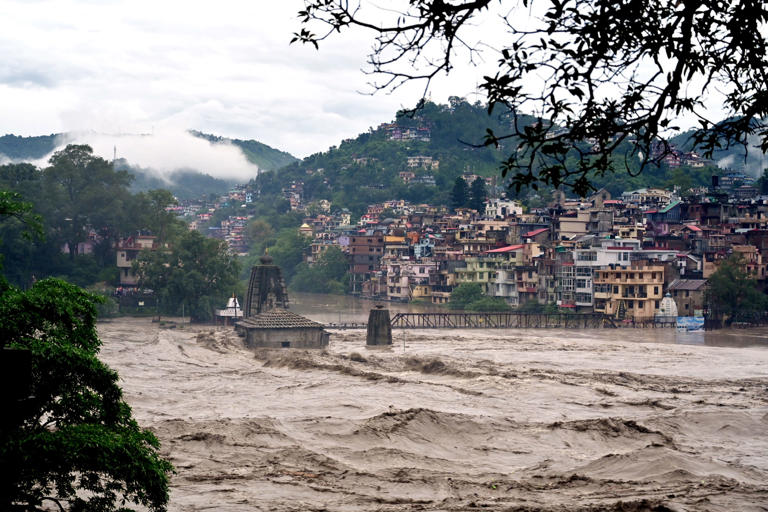
On Sunday, numerous areas of north India were hit by torrential rains that resulted in 19 fatalities due to landslides and other rain-related disasters. Most rivers, including the Yamuna in Delhi, were in flood. Numerous streets and residential areas were covered in knee-deep water in cities and towns around the region as a result of the municipal system’s inability to withstand the record rainfall.
People from Himachal Pradesh, Uttarakhand, and Delhi, among other places, shared terrifying images of the chaos brought on by the rains online, including pictures of cars floating like paper boats on inundated roads, muddy waters pouring into residential areas, temples and other buildings submerged on the banks of swollen rivers, and land cave-ins.
Certain regions of Jammu and Kashmir, Ladakh, and Himachal Pradesh have received heavy rain warnings, while officials in Delhi, which had its most rainfall on a single day in July since 1982, have issued concerns about the Yamuna’s increasing water level.
According to the India Meteorological Department (IMD), Chandigarh and Ambala in Haryana recorded record rainfall amounts of 322.2 mm and 224.1 mm, respectively, whereas Delhi only had 153 mm of rain in the 24 hours ending at 8:30 on Sunday.
According to Shimla Meteorological Office Director Surender Paul, Solan in Himachal Pradesh got 135 mm of rain on Sunday, beating a record set 50 years ago of 105 mm in a day in 1971. Una recorded the most rainfall after 1993.
Schools in Delhi and its neighboring NCR towns of Gurugram and Noida would be closed on Monday as a result of the paralysis of daily life, according to authorities. Schools in Ghaziabad will be closed for two more days owing to rain and then till July 17 due to the “kanwar yatra” after that.
Additionally impacted are railway services. According to the Northern Railways, owing to waterlogging, roughly 17 trains have been canceled, over 12 others have been rerouted, and movement has been interrupted at four points.
Five persons were killed in three different landslides in Himachal Pradesh, where a red signal for unusually heavy rainfall has been issued for 10 districts.
In the Kotgarh neighborhood of the Shimla district, three family members were murdered in a home collapse that followed a landslide, while Kullu and Chamba districts each reported one fatality.
A girl was buried in Rajhana hamlet, which is on the outskirts of Shimla, after a significant quantity of rain-swept debris fell on her home. Rescue efforts are in progress, according to officials, after it was reported that an elderly lady was trapped beneath rubble.
The Himachal Pradesh emergency operation center reports that 14 large landslides, 13 flash floods, and over 700 road closures have occurred in the last 36 hours.
All state-affiliated universities and institutions were shut down by the Himachal Pradesh government on Monday and Tuesday.
Three pilgrims from neighboring Uttarakhand perished in the Ganga when their jeep slipped off the Rishikesh-Badrinath National Highway near Gular and into the river.
Police and state disaster response force officers said that there were 11 passengers in the vehicle. According to them, five individuals have been saved, and rescue workers have also found three corpses while looking for three more.
Two homes collapsed in the state’s Kashipur region, killing a couple and wounding their granddaughter, while a police officer in Uttarkashi district’s Barkot died after being struck by a boulder that tumbled down a hill while directing traffic on the Yamunotri National Highway.
In Jammu and Kashmir, two people died when a passenger bus was struck by a landslide in the Doda district, while a man died in Ladakh’s Kargil area after his car was crushed by a rock that tumbled down a hillside along the Leh-Srinagar national route.
The bodies of two soldiers who were killed on Saturday while crossing the Dogra Nallah during a flash flood were found in the Union Territory’s Poonch region.
The yatra to the Himalayan cave shrine of Amarnath started on Sunday from the Panjtarni and the Sheshnag base camps after being delayed for three days, offering some reprieve to Srinagar from the intense rain.
In addition, reports of snowfall came from Ladakh, where a red warning for heavy showers has been issued, as well as from high-altitude regions of Jammu and Kashmir.
Due to indications that the water level in several rivers and streams in Jammu & Kashmir’s Kathua and Samba districts, as well as lower catchment regions, has beyond the danger threshold, a red warning has been issued.
About 200 people were stuck in Chandratal, Himachal Pradesh’s Lahaul and Spiti, after flash floods in hill regions, and the Beas river’s raging waters wiped away a portion of the Chandigarh-Manali route. Villages in Uttarakhand’s hilly areas have become unreachable by road owing to landslides and cave-ins brought on by severe floods.
Additionally, there were reports of automobiles being carried away in flash floods at Nullah in Kullu, Kinnaur, and Chamba in Himachal Pradesh, as well as stores being swept away in Manali.
Authorities stepped up their response efforts in the worst-affected districts after heavy monsoon rains caused significant waterlogging and floods in low-lying areas in numerous sections of Punjab and Haryana.
Ministers, deputy commissioners, senior superintendents of police, and other responsible authorities have been ordered by the Punjab government to go to the affected districts and provide the necessary aid to the populace.
Three rivers, the Markanda, the Ghaggar, and the Tangri, are running dangerously near to the danger threshold in Haryana, where a flood control room has been built.
The state of Gujarat’s Gurugram had major waterlogging and traffic congestion as a result of heavy rains, and the government advised businesses to work from home on Monday and announced a vacation for schools.
According to authorities, a guy drowned in a pond amid heavy rains in the hamlet of Gairatpur Bas in the Gurugram district, and another person is being sought. They said that the Churu district cousins from Rajasthan had gone to take a bath.
The Delhi government stated on Monday that all schools would be closed due to the heavy rains. It also canceled the government employees’ Sunday vacation and told them to work in the field. Waterlogging caused traffic problems as people had to wade across flooded roadways, cars were stranded, and underpasses became flooded.
A 10-year-old girl died on Sunday when a tree limb fell on the tin shed of her home in Kaushambi as a result of widespread rainfall in Uttar Pradesh. A lady and her six-year-old daughter were murdered in Muzaffarnagar after the roof of their home fell as a result of heavy rain.
Three individuals were hurt and two people were killed by lightning strikes in Ballia on Saturday.
In Rajasthan, certain parts had severe to extremely heavy rains while many other areas experienced moderate to high rainfall.
According to the IMD, the abundant rains that fell throughout most of India during the first eight days of July have made up for the country’s overall rainfall shortfall. The total amount of rain that has fallen throughout the monsoon season is 243.2 mm, which is 2% more than the average of 239.1 mm.
There are substantial geographical variances in rainfall, however.
According to the most recent IMD statistics, north India has received 59% more rain than usual (199.7 mm compared to a normal of 125.5%), while the eastern and northeastern area has seen a shortage of 17% (375.3 mm compared to a normal of 454 mm).
With a typical rainfall of 255.1 mm, Central India, where many farmers depend on monsoon rains, had 264.9 mm of rainfall, or an increase of 4%. In south India, there is now a 23% rather than a 45% rainfall deficit.
According to the IMD, a western disturbance and monsoonal winds are interacting to provide an intense rainfall spell across northwest India, including Delhi, which saw the first “very heavy” rainfall of the season.