
























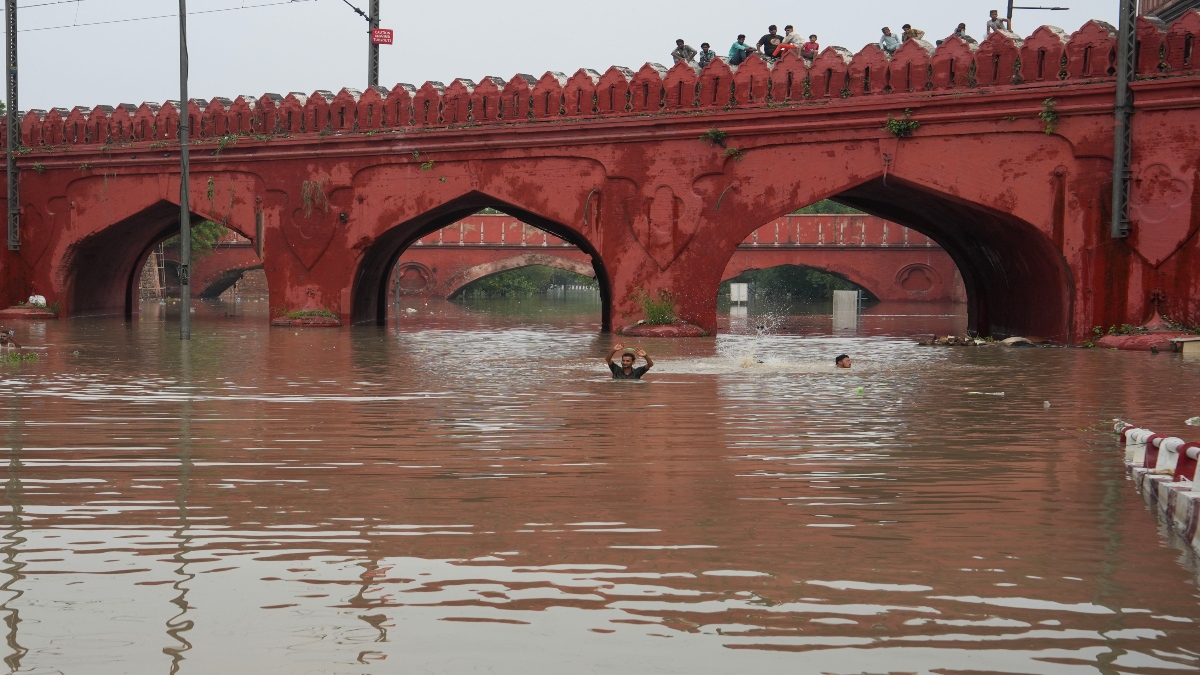
The Hathnikund barrage, upstream on the Haryana-UP boundary, which controls the flow of water in the Yamuna, has come into sharp spotlight as a result of the flooding in Delhi. The Aam Aadmi Party said on Friday that it was being intentionally mismanaged to flood the Capital.
It is crucial to comprehend the barrage’s operation for this reason.
The Upper Yamuna River Board, which is made up of representatives from all riparian stakeholders of the river, including Himachal Pradesh, Haryana, Delhi, Uttar Pradesh, and Rajasthan, regulates water through the Hathinikund barrage (which is not a dam and has no reservoir or overflow channel). This board works to ensure that each state receives the share of water agreed upon on May 12, 1994.
To settle a long-running Yamuna water dispute between several states and to make sure that the states get enough water for consumption and agriculture, the agreement was made under the auspices of the former Water Resources ministry, now known as the Jal Shakti ministry.
In accordance with the agreement, the Upper Yamuna River Board was established to oversee all water storage and barrages on the Yamuna until Okhla in south Delhi, after consulting with the floodplain states. Construction on the Hathinikund barrage, which began in 1996 and was finished in 1998, replaced the Tajewala barrage, which was located 3 km downstream.
According to the agreement, the Hathinikund barrage (HKB) controls the flow and distributes a portion of the water from the Yamuna’s main stream to the Haryana-controlled Western Yamuna Canal (WYC) and the Uttar Pradesh-controlled Eastern Yamuna Canal (EYC). Through Hathinikund, Delhi is planned to get 0.580 trillion cubic metres of water from the Yamuna annually.
When the Yamuna approaches the plains, 172 kilometres (km) from its source in Yamunotri, Uttarakhand, the barrage at the Tajewala hamlet in the Yamunanagar district provides a minimum flow of 10 cumec (cubic metre per second) water. 35.5 cusecs (cubic feet per second) make up one cumec.
“The barrage just controls water flow in accordance with the agreement and water sharing policies of the Central Water Commission; it does not halt the flow of water on the Yamuna River. According to the regulations, the Haryana government manages the barrage, according to a Jal Shakti ministry official.
The Bharatiya Janata Party (BJP)-run Haryana government was accused on Friday by the AAP, which now controls Delhi, of not diverting the extra water to Uttar Pradesh and instead releasing all of the water from Hathinikund to Delhi. According to the BJP, Delhi would not have flooded if the extra water had been transferred to Uttar Pradesh.
“Water has been released by the Haryana government in one way since July 10 when it could have been split equitably across the three states, according to the report. The flood in Delhi was planned. According to senior AAP leader and Rajya Sabha MP Sanjay Singh, the BJP intentionally put the nation’s capital in this predicament and let people suffer for political purposes.
According to Haryana irrigation authorities, the rules that regulate the distribution of water include one important need. The CWC water sharing formula is used when the water flow drops below 100,000 (1 lakh) cusecs, according to executive engineer Sandeep Kumar of the Haryana Irrigation and Water Resources Department. According to the calculation, in such case 15,000 cusecs would be released into the western canal, 2,000 cusecs would be discharged into the eastern canal, and the balance would flow into the main Yamuna.
“If the water flow exceeds 1 lakh cusecs, there will be no flow into the western and eastern canals and the entire water is to be discharged into the main Yamuna as two canals cannot withhold the high flow of water,” he added. This is due to the fact that the increased water intensity, as measured by cusec flow, might harm the artificial canals, he continued.
At 3 p.m. on Friday, when the water flow at Hathinikund was decreased to 58,495 cusecs, 10,510 cusecs of water were released into the western canal, which supplies drinking water to Delhi’s northern neighbourhoods, while the eastern canal did not get any releases. “The UP has not demanded water because there is a breach in the eastern canal in UP and the water will be discharged when the UP government raises demand,” an official said.
AAP responded when approached by phone or email with the following statement: “So the Centre’s strategy was always that anytime there is a natural disaster in Yamuna, the Delhi side will be inundated. Why can’t the western and eastern Yamuna canals be opened in the case of such a disaster, even though they were designed for irrigation? How, therefore, did water begin to be allowed into both the western and eastern canals today after AAP forcefully addressed this concern, if all of this were in fact true? Did the CWC rules just abruptly change?
According to Devender Singh, Manohar Lal Khattar’s adviser on irrigation, the Hathinikund is a barrage that controls water flow rather than a dam that can hold water. “The water discharged into the Yamuna river, for the protection of the barrage, is the water which is constantly coming from Himachal Pradesh and Uttarakhand these days due to excessive rains,” he said in a statement.
Virendra Sachdeva, the head of the Delhi BJP, denied the AAP’s claims. Technical officials make the decision as to when and how much water would be released from any barrage or dam, he said.