
























Ibrahim Mohamed turned in his hospital bed to discover that the patient next to him had passed away, but the corpse could not be transported due to violence that had broken out in the capital of Sudan hours before.
Since April 15, fighting between the armies of two opposing generals has transformed Khartoum into a war zone, closing hospitals and making it impossible for medical personnel to provide treatment.
The corpse was still there on Tuesday when Mohamed, a 25-year-old leukemia sufferer, was eventually taken out of the Khartoum Teaching Hospital.
Mohamed’s father, Mohamed Ibrahim, 62, told AFP that the body could not be relocated and buried because of the fierce fighting.
The Sudanese physicians’ union’s general secretary, Attiya Abdullah, said that other hospitals had the same issue.
According to him, “decomposing dead bodies are kept in wards” because there is nowhere else to put them.
According to Abdullah, “morgues are packed and the streets are littered with bodies” as a result of explosions, intense shooting, and air strikes that have killed hundreds in the nation’s capital and other regions.
He claims that the “complete and total collapse of the healthcare system” has been brought on by urban warfare between troops loyal to Sudan’s army leader Abdel Fattah al-Burhan and his deputy-turned-rival, Mohamed Hamdan Daglo, the head of the powerful paramilitary Rapid Support troops (RSF).
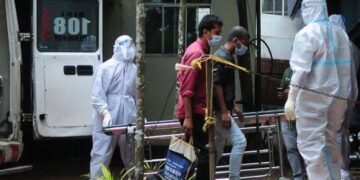
Ibrahim and his kid waited in the medical ward while being subjected to constant explosions; according to the father, “the stench filled the room,” which was made worse by power shortages in the sweltering heat.
We had two options: remain in the offensive room or risk being shot at if we went outside.
HOSPITALS UNDER FIRE
After three days without food, water, or power, the father and son eventually fled on Tuesday about 1:00 pm, but not to safety.
Ibrahim said, “The hospital was being shelled.”
13 hospitals countrywide have reportedly been bombarded, and 19 more have been evacuated, according to the physicians’ union.
According to the World Health Organization (WHO), assaults on medical institutions have resulted in at least eight fatalities.
Ibrahim said that “the RSF and the army were fighting right outside the hospital,” adding that some of the people fleeing themselves came under fire.
Doctors are faced with a difficult decision as bombs begin to fall close to medical facilities.
Abdullah stated, “We find ourselves having to let patients go. “They would die if they stayed,”
Ibrahim was able to protect his ill kid from the gunfire, but he “had to go on foot” through the streets, scurrying from one safe location to the next.
They traveled for five hours before arriving “safely, but my son’s health has since deteriorated,” the father claimed.
There was nowhere else for Mohamed to go since “operational hospitals only providing emergency services” and roughly three-quarters of hospitals were closed, according to Abdullah.
His father replied, “I just want all of this to end so I can take my kid to be cured.
MEDICS ‘EXTREMELY EXHAUSTED’
Even hospitals that have stayed open, treating largely gunshot wounds, “are at risk of closure at any time,” according to Abdullah.
There is not enough surgical equipment, generator fuel, ambulances, or blood, among other things.
The WHO said that the violence in Sudan had resulted in 413 fatalities and 3,551 injuries, but the true death toll is likely far higher since medical professionals and relief workers were unable to reach those in need.
According to Abdullah, “some hospitals have had the same team working” for eight days in a row.
Some only employ a single surgeon. We are all quite worn out.
Daily calls for a ceasefire have been made by medical professionals so that aid workers and the injured may be transported and the deceased can be laid to rest.
But even when there have been small lulls in the fighting in Khartoum, the crackling of gunfire has regularly replaced the fleeting stillness, and no cease-fire has been able to hold.
UNICEF has issued a warning that fuel shortages and power outages might jeopardize the cold storage of more than $40 million worth of vaccinations and insulin. This warning came as people mobilized on social media to locate any sources of medicine for their chronically sick relatives.
The physicians’ organization posted tips on Facebook about how to handle, enshroud, and bury decaying remains on Friday after a third truce failed.