






















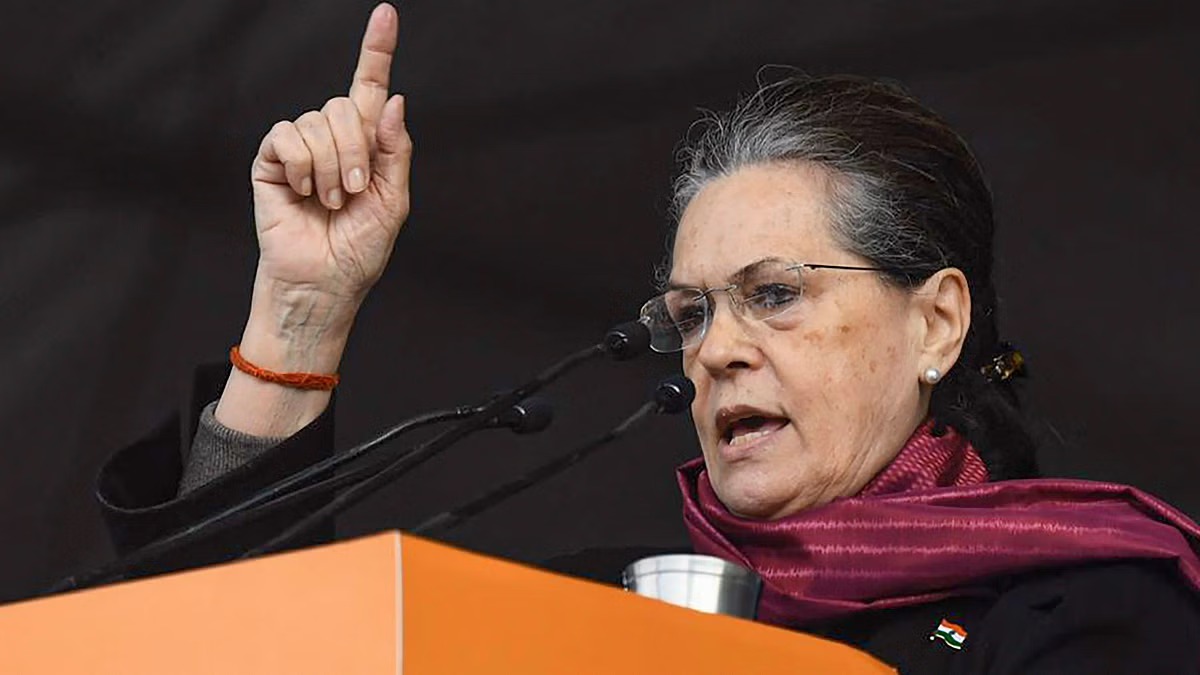
Congress leader Sonia Gandhi described secularism as the cornerstone of India’s democracy and said that the term secular is being exploited as a “pejorative” by people in positions of power, which is causing further polarization in society.
“They claim to be devoted to ‘democracy,’ yet they undermine the checks and balances that are supposed to guarantee its efficient operation. In a signed essay for the Manorama Yearbook 2024, Gandhi said, “The train tracks meant to guide our nation to harmony are being damaged and the results are already being seen in the increased polarization in society.”
Secularism and democracy have a close relationship; they work together like two rails on a track to steer the current administration toward the goal of a peaceful society.
These are phrases that are common to all of us; they appear in speeches, debates, civics textbooks, and the Preamble to the Constitution. Even with this familiarity, these terms’ inner meanings are often obscure. Every person would be better able to comprehend India’s past, current difficulties, and future course if they have a thorough comprehension of these phrases, according to the former head of the Congress.
Gandhi said that although secularism may be understood in a variety of ways, the definition that Mahatma Gandhi established in his well-known phrase, “sarva dharma sama bhaava,” is the one that is most pertinent to India.
Gandhi saw the fundamental similarity across all faiths. She is reported as stating in a statement published by Malayala Manorama here: “Jawaharlal Nehru was deeply conscious of India being a multi-religious society, so he constantly strove to establish a secular state.”
She also said that this concept was conceived and implemented by the Indian Constitution writers, under the direction of Dr. B R Ambedkar, to create a distinct secular democracy.
The state defends everyone’s right to practice their religion. It has unique clauses designed to safeguard minorities’ wellbeing. The senior Lok Sabha MP said, “Promoting harmony and prosperity between all the diverse groups in our society is always the guiding principle of Indian secular democracy.”
Gandhi, who presided over the Congress party for more than 20 years—from 1998 to 2017 and from 2019 to 2022—said that India’s remarkable variety has always served as its defining characteristic.
In reality, because “diversities” include a wide range of religions and beliefs, languages and cultural practices, locations and ecologies, histories and customs, it makes more sense to refer to them as “diversities” in our society than as merely “diversity.” However, our Founding Fathers left us with the heritage of oneness in Diversity because there has always been a feeling of underlying oneness, she said.
“When diversity is celebrated, as it is in our wonderful Constitution, which is currently under attack, it strengthens our unity and solidarity,” the speaker said.
Gandhi also brought up a crucial point about how democracies operate. A majority of votes determines the formation of the government in a democracy.
But can those in the majority always have the upper hand over the others if they agree? What happens when a small group’s fundamental interests are harmed? What should be done if a temporary majority insists on making a choice that might have serious ramifications down the road? But do they have the right to rule without opposition if a stable but small majority is established? she questioned.
In multicultural nations like India, where individuals hold a great deal of significance for one another’s many identities, this dilemma is particularly serious.
“It does not help peace or harmony in society if people worry that their language, religious practice, or way of life could be permanently threatened only because they were not many in number,” the speaker said.
Jawaharlal Nehru once observed that “democracy is good.” Gandhi used this to argue that democracy is not a perfect system. I mention this because there are worse systems. It has both positive and negative aspects.
The freedom warriors established guidelines to prevent these maladies, such as a written Constitution, people’ fundamental rights against the government, and the secularism principle, since they understood from the experience of democracy in other nations that the system is prone to sicknesses.
She stated: “It is time for us too, to find our own solutions to the challenges of today, and in so doing, serve and honor our nation.” She pointed out that progressive individuals in India have always attempted to find solutions to the times’ challenges.