























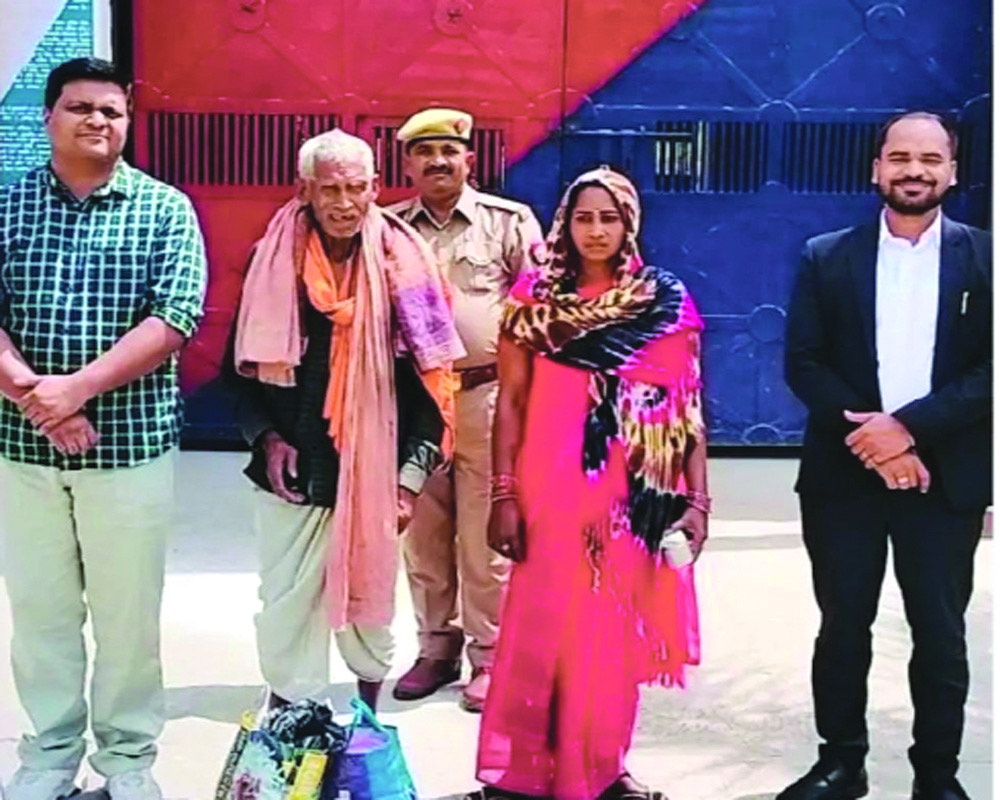
If you ask Lakhan Saroj, 104 years old, the last fifty years have been a long time. Lakhan was accused of murder in 1977, when he was only 56 years old. He was finally found not guilty 48 years later, decades after the event that changed his life forever. Justice was delayed, denied.
Lakhan is sitting on a woven cot in a muddy backyard in the Kaushambi district. His weak body and sore legs tell a more powerful story than his words. It’s hard for him to stand or walk without help. When asked what caused the fight so many years ago, he can still remember it clearly. “There was trouble with Jagan and Prabhu, who are from our community.” “First they broke my aunt’s hand, and then my uncle’s leg,” he says. “They told us not to fight back.” But on August 6, 1977, 10 or 12 of them came in drunk and with sticks in their hands. They came at us and we fought back. During the fight, Prabhu got hurt. He died afterwards.
Lakhan, Kalesar, Deshraj, and Kallu were all caught by the Sarai Akil cops and sent to jail. They were freed on bail after a few days, but the murder trial went on for too long. All four were given life sentences by the Sessions Court in Prayagraj in 1982. Lakhan decided to go to the High Court, but what happened next was a mess of legal delays, lawyers who didn’t show up, and general neglect.
He says, “Over the years, we hired some lawyers, but they took the money and ran.” “We didn’t understand how the court worked.” When we asked at the police station, they always told us to “go home” because nothing would happen. Many years went by in limbo. He was then sent to Naini Jail in Prayagraj in 2014. He was over 90 years old and could hardly walk. “Because I was old, they didn’t make me do any work in jail.” “Everyone was nice to me,” Lakhan says quietly.
“My girls got me out of jail.” “My son did not help.” Lakhan didn’t know much about what was going on in court. He missed court dates because his address kept changing, and he often stayed at the homes of different children. Police were given warrants, but they never found him at the address they had. In the end, in December 2024, the High Court ordered his arrest to ensure he was present when his appeal reached its final stages. The man was sent to jail in Manjhanpur. By then, almost everyone who had been involved in the case had died or lost the ability to do so. The people who filed the FIR had died. Kallu and Kalesar, who were both charged, were dead. Deshraj was unable to get out of bed. It was now “Lakhan vs. State.”
Even in its last days, the case took a sad turn. Lakhan was found not guilty by the High Court in early 2025; however, he remained in jail for an additional 20 days. Why? Sending the release request took too long due to bureaucratic delays.
Purnima Pranjal, the additional district judge for Kaushambi, stated, “We carried out the warrant and sent him to jail in December because his appeal was still pending and the High Court needed him to be present.” We had to wait for the release order from the CGM court in Prayagraj after he was acquitted. It got there late.
Asha, Lakhan’s fourth daughter, says, “This fight began before we were born.” We had to fight for our dad because my brother never helped him. In 2014, he spent three years in jail. He stayed 20 more days this time, too, because the papers were not sent on time.
Lakhan was married twice and had one son from the first marriage and five girls from the second. During his last court case, his children stood by him. His name is clear now, but the years he lost will never come back.
Lakhan says in a shaking voice, “I did not understand courts.” I knew I hadn’t killed anyone, though. I did nothing but wait.
A man who spent half his life haunted by a false belief now only wants peace. Justice came late for Lakhan Saroj, but it did come. It is high time India took justice seriously and valued the lives of its citizens. The lack of a sufficient number of judges is not an excuse that the judicial system can settle on now.