






















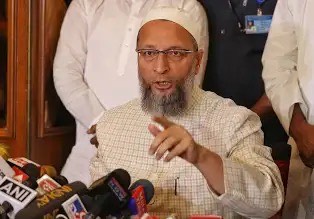
In a statement released on Monday, the leader of the All India Majlis-e-Ittehadul Muslimeen (AIMIM), Asaduddin Owaisi, voiced his opposition to the concept of “One Nation, One Election.” He stated that the proposal will be a “disaster” for Indian democracy and federalism and that it is a “solution searching for a problem.”
In a letter addressed to Niten Chandra, the secretary of the high-level committee that has been led by former President Ram Nath Kovind and has requested proposals for the implementation of the plan, Owaisi stated that simultaneous elections are neither constitutionally permissible nor required nor practicable.
In my capacity as a member of parliament and the president of the All India Majlis-e-Ittehadul Muslimeen, I am writing to express my opposition to the notion of “One Nation, One Election.” Within this document, I have attached my substantive concerns to the proposal that is founded on constitutional law. On June 27, 2018, when the Law Commission of India was looking for suggestions regarding the matter, the same objections were additionally communicated to the commission. Additionally, I have attached an article that I wrote for the Hindustan Times on the subject of the matter, which was published on March 12, 2021,” Owaisi added.
Owaisi reiterated his criticisms and stated that every consultation on this matter has “sidestepped” the first need of lawmaking in democracies, which is to describe why a policy has to be formed. He also stated that the administration has not presented any reason for the policy that needs to be made. “Neither the Parliamentary Standing Committee, NITI Aayog, nor the Law Commission have demonstrated why such a step needs to be taken,” Owaisi stated in the letter. He said that the conversation has instead been centred on how it may be implemented. The AIMIM chairman noted that this was the focus of the discussion.
Furthermore, he asserted that the “same flaw” is present in the high-level committee and that the primary focus is on the “creation of an appropriate legal and administrative framework for holding simultaneous elections permanently.” He stated that this was the case.
“More importantly, it has not been explored whether such fundamental changes to India’s democratic structure are constitutionally permissible in the first place,” he pointed out. “This is a potentially significant issue.” “This is a solution in search of a problem.”.
In addition to this, Owaisi stated that elections are not merely a formality and that voters are not a set of predetermined choices. It was his contention that elections should not be susceptible to “weak” concerns such as administrative convenience or economic viability, among other things.
If constitutional requirements were susceptible to financial or administrative concerns, then it would lead to ludicrous conclusions. For example, should one get rid of permanent civil services or police because of the costs involved? In the letter, he posed the question, “Should one stop recruiting judges because of what is currently going on?” “I urge the HLC to duly record the finding that simultaneous elections are neither constitutionally permissible nor necessary nor viable,” said Owaisi further.
In a statement made the previous week, Mamata Banerjee, the chief minister of West Bengal, expressed her opposition to the concept of “one nation, one election.” She stated that, despite the fact that the phrase is dramatic and exciting, it is in direct opposition to the federal system of Nepal.
Ram Nath Kovind, a former president of the nation, heads the committee “One Nation, One Election,” which is looking for suggestions from the general public “for making appropriate changes in the existing legal administrative framework to enable simultaneous elections in the country.”
Early in the previous year, the government established the high-level committee, which had eight members and was under Kovind’s direction.