





















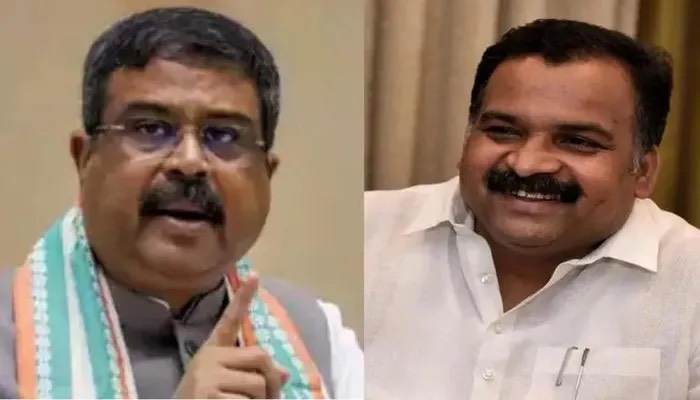
Congressman Manickam Tagore reported on Thursday, August 24, that he had written a letter to Union Education Minister Dharmendra Pradhan requesting that the Central Board of Secondary Education (CBSE) reconsider its intention to organise an exhibition on topics related to the partition of India and Pakistan.
In his letter dated August 21st, the Congress MP from Tamil Nadu’s Virudhunagar highlighted worry over CBSE’s decision to organise exhibitions on the theme of division claiming that such a move would instil hatred into the brains of India’s younger generations. Tagore requested the Centre to ‘preserve’ societal harmony by retracting its decision in this regard.
“I express my concern towards the decision made by the Central Board of Secondary Education (CBSE) regarding the organization of exhibitions on the theme of ‘Partition’ in schools. I urgently urge you to reconsider and revoke this decision so as not to create animosity among the minds of our younger generations and to protect the social harmony of our society,” Tagore stated in his letter.
The Congress MP further asserted that although it is important to learn from the events of the country’s history, this subject should be approached with “sensitivity and consideration for the impressionable minds of our youths.”
Furthermore, the letter read like a delicate balance between the Congress MP’s urging that young students be taught about history in a way that “fosters understanding, compassion, and a sense of unity among our young generations” and his discussion of the significance of learning about historical events.
The letter also stresses that exhibitions centred around the bloodshed and atrocities that transpired during the partition in 1947 could “inadvertently perpetuate negative emotions and divisive sentiments” adding that such a move would be in stark opposition to India’s goal of nurturing responsible citizens who value harmony and unity.
As previously mentioned, the CBSE issued a circular on August 14th requesting that exhibitions be organised in honour of “Partition Horrors Remembrance Day” based on topics relating to division.
While Congress’s Manickam Tagore said that having such displays will foster hatred in the hearts of young kids, the CBSE circular had already recommended that “the exhibition be showcased with the sobriety and solemnness that it deserves. The protection of the feelings of any societal group may be particularly guaranteed.
The leader of the Congress further said that young kids’ minds should be shaped in such a way that they embrace diversity through the school system.
Manickam Tagore urged Minister Pradhan to reverse the CBSE’s decision as he concluded the letter.
Interestingly, Tagore urged the Centre to teach students about historical events, in this context, events centred around India’s partition, in such a manner that it fosters compassion and a sense of unity. The issue here is how CBSE will portray the atrocities of Direct Action Day, the Islamists’ massacre of Hindus, and how on August 14, 1947, a united India was arbitrarily split into three parts—India, West Pakistan, and East Pakistan—at the cost of the genocide of more than 2 million Indians in a way that would promote harmony and compassion.
The truth should be revealed as it is because the young people of India ought to be aware of the atrocities that their forefathers faced while the British just watched while some Congress leaders, including Mohammad Ali Jinnah, decided how much power they would share.
It is significant that just days before, Nationalist Congress Party (NCP) chairman Sharad Pawar had also made similar comments over CBSE’s intention to organise exhibitions on division. The head of the NCP has expressed concern on a CBSE circular that states “it will not be suitable to imbibe a history in the minds of the young generation which includes bloodshed and bitterness.”
The argument that teaching the younger generation about the bloodshed and horrors of partition will instil bitterness and hatred in their minds, preventing them from becoming responsible citizens, does not hold water as it is only when the younger minds who will become India’s future leaders know their history free of bias, cover-ups, and propaganda that they will understand what mistakes made in the past must not be repeated in the future.