






















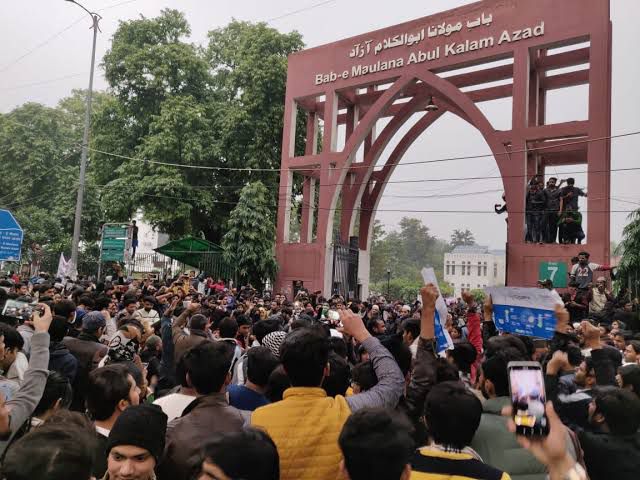
While we are talking about progress, infrastructure and G20, we are still fighting demons like a lack of understanding of facts, history and unity. Every state in India experiences protests before we bring about any new idea or instrument of change. Somehow the youth believes more in arguments than debate and turmoils than solutions. Unfortunately, 90% of protestors do not really know why they are protesting and what is the actual objective of their uproar. The Jamia violence of 2019 was a protest of students against the Citizenship Amendment Act. How many students knew what it meant and how many had read the CAA document is a big question.
Before understanding what it was, celebrities like Swara Bhaskar had already started condemning it. In one of the forums when Swara Bhaskar was asked if she had read the document, her answer was no. On the day of the protest, the way an educational institute was turned into a battleground was a sight to see. However, the Delhi Police entered the university premises and stalled this protest. We all know that thousands of students cannot be controlled so easily. They arrested a few students on the pretext of rioting and disturbing peace. Some were beaten and dragged too. The sad part is that many innocents have to face the brunt because of some overconfident brats who convince them into joining something they don’t have any clue about. Words cannot explain a situation like this. Many were hurt and admitted to the hospital. We still need to rethink what the students were protesting about when a proper idea of CAA wasn’t even on paper. Whatever the case, students must not suffer for sure. What happened and how students witnessed horror was certainly not something the students should have experienced.
Today Delhi High court partly overturned the trial court’s decision and filed charges for a variety of offences, including rioting and unlawful assembly, against nine of the eleven defendants, including Imam, Tanha, and Zargar. Earlier they had discharged Sharjeel Imam, Safoora Zargar, Asif Iqbal Tanha, and eight other people in connection with the violence at Jamia Millia Islamia in December 2019. A single-judge bench of Justice Swarna Kanta Sharma today framed charges against the accused under several IPC sections.
Justice Swarana Kanta Sharma said in her order,
“While there is no denial of the right to freedom of expression, this Court remains aware of its duty and has tried to decide the issue in that way. Right to peaceful assembly is subject to restriction. Damage to property and peace is not protected.”
With the latest verdict, Imam, Zargar, Mohd Qasim, Mahmood Anwar, Shahzar Raza, Umair Ahmed, Mohd Bilal Nadeem and Chanda Yadav have now been charged under Sections 143 (unlawful assembly), 147 (rioting), 149 (disturbance to public tranquillity), 186 (obstruction of public servants from performing their duties), 353 (assault on public servants), and 427 (mischief causing damage to the amount of fifty rupees) of the Indian Penal Code (IPC), as well as sections of the Prevention of Damage to Public Properties Act.
On the other hand, accused Mohd Shoaib and Mohd Abuzar have been charged under Section 143 of the IPC, and discharged from all other offences. While Tanha has been discharged of Sections 308 (attempt to commit culpable homicide), 323 (punishment for voluntarily causing hurt), 341 (punishment for wrongful restraint), and 435 (mischief by fire or explosive substance) of the IPC, he has been charged under other sections.
The current case concerns the violence that occurred in and around Jamia Millia Islamia in December 2019 following announcements made by some students and locals that they would march towards Parliament to oppose the Citizenship Amendment Act (CAA) and the National Register of Citizens. (NRC) is worth researching. Majorly because it proved that a protest against something that is not known clearly can also lead to such an event.
Mentioning Safoora Zargar, the student activist specifically. She was pregnant at the time of the arrest. Jail is not a human place for anyone. Her struggle to survive in jail at such a time must have been difficult, especially when she was carrying another life. Hurt, damage and pain to anyone are not acceptable. Seldom do we remember this. The protestors should also have considered that the rules apply to all. Violence and screaming out loud can never be a solution. There are legal formal ways to say what we have to. But if this is said to the younger generation, they quickly give references to protests at the time of independence and forget that the country that they are living in is the most tolerant one in this world.
The Honourable court is the final authority and today has chosen to state that freedom of expression does not mean disturbing anyone or destroying anything. While the whole country feels sad that young students, pregnant women and many innocents went through something as bad as a nightmare, we also should highlight the fact that violence and destruction cannot be taken lightly in our country.